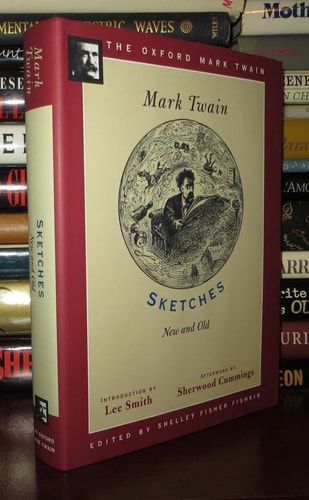
Sketches, New and Old
0
0
As an Amazon Associate and affiliate partner, Menrva Books earns from qualifying purchases. Learn more
Author Description
A real storyteller can make a great story out of anything, even the most trivial occurrence. Composed between 1863 and 1875, the sixty-three often outrageous sketches in Sketches, New and Old contain, for instance, a piece about the difficulty of getting a pocket watch repaired properly; complaints about barbers and office bores; and satirical comments on bureaucrats, courts of law, the profession of journalism, the claims of science, and the workings of government. In Mark Twain's hands, all these potentially dry and dull topics bristle with vitality and interest. "What fascinates Twain," Lee Smith writes in her introduction, is how people "react to the things that happen to them." Twain "lets them speak in their own voices by and large, in a chorus ranging from high-flown oratory to the plain speech of working people.... It seems generally true that the more elevated the speech, the likelier that person is to be an idiot; words of wisdom and common sense are invariably voiced by the common man"--or woman. "The most profound and moving sketch in this whole collection" Smith writes, is one "told by a freed slave." The candid, ironic, playful, and petulant sketches in this volume are indispensable to our understanding of a harried genius during thirteen quite amazing years.
Menrva's Summary
THE PULSE
Mark Twain captures the absurdity of everyday life through a collection of sixty-three sketches that transform mundane frustrations into biting social commentary. The author navigates the social landscape of the mid-19th century, employing a variety of voices to critique the incompetence of bureaucrats, the pretension of the elite, and the mechanical failures of modern life. These narratives function as a series of observational vignettes, utilizing a mix of first-person accounts and character-driven monologues to expose the folly inherent in human institutions. The world presented is one of rapid industrialization and shifting social norms, where the protagonist or narrator often finds themselves at odds with the rigid structures of journalism, law, and science.
INSIDE THE PAGES
- Satirical examination of professional institutions including journalism and law
- Use of vernacular speech to distinguish social classes
- Observational humor centered on trivial daily inconveniences
- Inclusion of diverse character perspectives ranging from working-class individuals to freed slaves
- Critique of bureaucratic inefficiency and government incompetence
- Stylistic variation between high-flown oratory and plain, common speech
- Exploration of the human reaction to unexpected circumstances
- Ironic and petulant tone characteristic of Twain's mid-career writing
THE COLLECTIVE ECHO
Readers and critics frequently highlight the collection as a vital window into Twain's development as a satirist during his most prolific years. Discussion often centers on the author's ability to elevate mundane topics like watch repair into complex social critiques through his sharp wit. Many observers note the effectiveness of his character-driven approach, which allows the voices of common people to contrast sharply with the idiocy of the elevated classes. The pacing of the sketches is generally viewed as brisk and accessible, making the collection a frequent point of reference for those interested in the evolution of American humor. The work remains a significant study in how Twain utilized irony to dismantle the pretensions of his contemporary society.
Page Count:
400
Publication Date:
1996-12-05
Publisher:
Oxford University Press
ISBN-10:
0195101359
ISBN-13:
9780195101355
Humor
Satire
American
Short Stories
Classic Literature