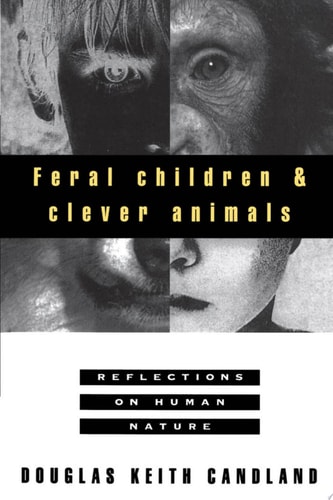
Feral Children and Clever Animals: Reflections on Human Nature
0
0
As an Amazon Associate and affiliate partner, Menrva Books earns from qualifying purchases. Learn more
Author Description
In this provocative book, Douglas Candland shows that as we begin to understand the way animals and non-speaking humans "think," we hold up a mirror of sorts to our own mental world, and gain profound insights into human nature.Weaving together diaries, contemporary newspaper accounts, and his own enlightening commentary, Candland brings to life a series of extraordinary stories. He begins with a look at past efforts to civilize feral children. We meet Victor, the Wild Boy of Aveyron, now famous as the subject of a Truffaut film; Kaspar Hauser, raised in a cell, civilized, and then assassinated; and the Wolf Girls of India, found early this century huddled among wolf pups in a forest den (they were originally believed to be ghosts by superstitious villagers, who nearly shot them as they were being captured). In each case, it was hoped that the study of these children would help clarify the age-old nature/nurture debate, but, as Candland shows, so much of the information "revealed" was really only a projection of beliefs previously held by the investigating scientists.Candland then turns to "clever animals." We learn how the investigation of "Clever Hans," the German horse who could calculate square roots, proved to be a first step in the direction of behaviorism (researchers found that Hans was being tipped off by the subtle and unwitting body language of his owner and other observers, who would bend almost imperceptibly at the waist with every hoof beat, and stand erect when the correct count was reached). And Candland discusses the many attempts to communicate with our closest neighbor, the apes. We read of Richard Lynch Garner's 1892 experiment living with chimpanzees in Gabon (he taught one to say the French word "feu"), and of Gua, raised by W.N. and L.A. Kellogg alongside their own son Donald, and of the latest successes of teaching sign language to such precocious apes as Sarah, Sherman, Austin, and Koko. Throughout, Candland illuminates the boldest and most
Menrva's Summary
THE THESIS
This work investigates the fundamental question of what distinguishes human cognition from animal behavior by analyzing historical accounts of feral children and attempts to communicate with non-human species. Douglas K. Candland, a professor of psychology, utilizes a combination of historical diaries, archival newspaper reports, and scientific case studies to examine how human perceptions of nature and nurture have evolved. He argues that historical observations of these subjects often reveal more about the biases and projections of the researchers than the actual mental capacities of the subjects themselves.
THE SCOPE MAP
What You Will Find
- Historical case studies of feral children including Victor of Aveyron and Kaspar Hauser.
- Analysis of the Clever Hans phenomenon and its impact on the development of behaviorism.
- Documentation of early and modern attempts to teach language to chimpanzees and other primates.
- A critical examination of the nature versus nurture debate through the lens of developmental psychology.
THE AUTHORITY PERSPECTIVE
Experts and readers frequently cite this book as a comprehensive historical survey of the intersection between developmental psychology and animal cognition research. The text is noted for its accessible synthesis of complex scientific history and its balanced critique of past research methodologies.
Page Count:
432
Publication Date:
1995-10-26
Publisher:
Oxford University Press
ISBN-10:
0195102843
ISBN-13:
9780195102840
Science
History
Psychology
Nature
Anthropology
Naturalism
Community Tags
Similar Books