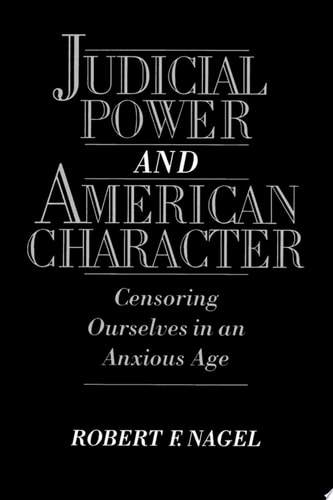
Judicial Power and American Character: Censoring Ourselves in an Anxious Age
0
0
As an Amazon Associate and affiliate partner, Menrva Books earns from qualifying purchases. Learn more
Author Description
This original work is an unusual effort to relate modern constitutional politics to the moral character of American culture. Writing in non-technical language, Nagel demonstrates how judicial decisions embody wider social tendencies toward moral evasiveness, privatization, and opportunism. He shows that constitutional interpretation is often used to stifle political disagreement and, ultimately, to censor our own beliefs and traditions.The discussion ranges over such controversial topics as political correctness on the campus and in the case law, resistance to constitutional rights like abortion, the confirmation hearings of Clarence Thomas and Robert Bork, and judicial decisions on such issues as pornography, flag-burning, gay rights, school prayer, and school desegregation. The analysis crosses conventional political and philosophical lines. Nagel sees fundamental similarities between liberal theorists like Ronald Dworkin and conservatives like Bork. He traces judicial arrogance to the ambitious doctrinalist, William Brennan, but also to the cautious incrementalist, John Marshall Harlan. He describes the highest rituals of legality as re-enactments of the same cultural deficiencies that cause concern for the rule of law, and he suggests that real protection for legal values lies in self-confident politics.Clearly written and forcefully argued, Judicial Power and American Character is an audacious examination of judicial power as an integral part of an increasingly anxious and intolerant culture. It will be of great importance to law professors, lawyers and judges, political scientists, and educated citizens interested in constitutional interpretation, the phenomenon of "political correctness", and the possibility of moral decline.
Menrva's Summary
THE THESIS
This book investigates the relationship between modern constitutional jurisprudence and the moral character of American culture, arguing that judicial power often serves to stifle political discourse and enforce a culture of moral evasion. Robert F. Nagel, a legal scholar, examines how judicial decisions reflect broader societal anxieties and tendencies toward privatization and opportunism. By analyzing the intersection of legal doctrine and cultural behavior, he posits that the judiciary acts as a mirror for, and a participant in, the erosion of robust political debate.
THE SCOPE MAP
What You Will Find
- Analysis of high-profile legal controversies including school prayer, flag-burning, and desegregation.
- Examination of the ideological parallels between liberal and conservative legal theorists.
- Critique of judicial decision-making processes in the context of political correctness.
- Discussion of the impact of constitutional interpretation on public moral character.
THE AUTHORITY PERSPECTIVE
Legal scholars and political scientists frequently cite this work for its provocative critique of judicial overreach and its unconventional synthesis of legal and cultural analysis. Readers note that the text remains accessible to non-specialists while providing a rigorous challenge to standard interpretations of constitutional law.
Page Count:
208
Publication Date:
1996-04-11
Publisher:
Oxford University Press
ISBN-10:
0195106628
ISBN-13:
9780195106626
Philosophy
American History
Censorship
Law
Sociology
Constitutional Law
United States
Judicial Power
Community Tags
Similar Books