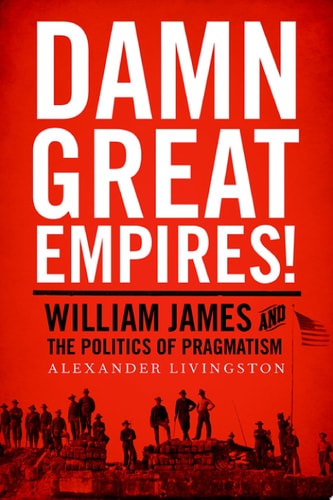
Damn Great Empires!: William James and the Politics of Pragmatism
0
0
As an Amazon Associate and affiliate partner, Menrva Books earns from qualifying purchases. Learn more
Author Description
Damn Great Empires! offers a new perspective on the works of William James by placing his encounter with American imperialism at the center of his philosophical vision. This book reconstructs James's overlooked political thought by treating his anti-imperialist Nachlass -- his speeches, essays, notes, and correspondence on the United States' annexation of the Philippines -- as the key to unlocking the political significance of his celebrated writings on psychology, religion, and philosophy. It shows how James located a craving for authority at the heart of empire as a way of life, a craving he diagnosed and unsettled through his insistence on a modern world without ultimate foundations. Livingston explores the persistence of political questions in James's major works, from his writings on the self in The Principles of Psychology to the method of Pragmatism, the study of faith and conversion in The Varieties of Religious Experience, and the metaphysical inquiries in A Pluralistic Universe. Against the conventional view of James as a thinker who remained silent on questions of politics, this book places him in dialogue with a transatlantic critique of modernity, as well as with champions and critics of American imperialism, from Theodore Roosevelt to W. E. B. Du Bois, in order to excavate James's anarchistic political vision. Bringing the history of political thought into conversation with contemporary debates in political theory, Damn Great Empires! offers a fresh and original reexamination of the political consequences of pragmatism as a public philosophy.
Menrva's Summary
THE THESIS
This book investigates the political dimensions of William James's philosophy by centering his critique of American imperialism as the primary lens for understanding his broader intellectual project. Alexander Livingston, a scholar of political theory, utilizes James's neglected anti-imperialist writings—including speeches, correspondence, and essays regarding the Philippine annexation—to challenge the long-standing academic perception of James as politically disengaged. By connecting these specific political interventions to his canonical works on psychology and religion, the author argues that James's pragmatism functions as a deliberate, anarchistic response to the authoritarian impulses inherent in modern imperial power.
THE SCOPE MAP
What You Will Find
- Analysis of James's anti-imperialist Nachlass and public political commentary
- Examination of the intersection between pragmatism and the critique of modern authority
- Comparative study of James alongside contemporaries like Theodore Roosevelt and W. E. B. Du Bois
- Reinterpretation of major texts including The Principles of Psychology and The Varieties of Religious Experience
Scope Limits
- The text does not provide a comprehensive biography of William James's entire life
- It does not focus on the technical psychological experiments of James's early career except where they inform his political vision
THE AUTHORITY PERSPECTIVE
Scholars of American intellectual history recognize this work as a significant intervention that corrects the historical tendency to view James as apolitical. Readers frequently note the academic density of the prose, which is intended for an audience familiar with political theory and the history of pragmatism.
Page Count:
257
Publication Date:
2016-01-01
Publisher:
Oxford University Press
ISBN-10:
0190626631
ISBN-13:
9780190626631
Philosophy
Pragmatism
United States
Political Theory
American History
American Government
Intellectual History
Community Tags
Similar Books