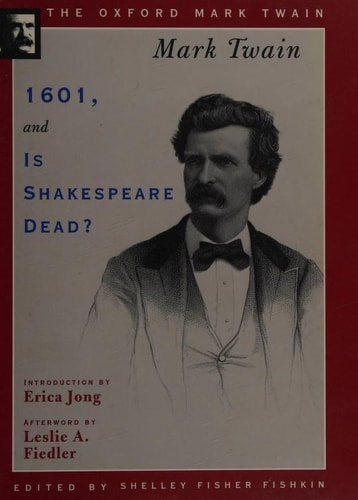
1601 And Is Shakespeare Dead?
0
0
As an Amazon Associate and affiliate partner, Menrva Books earns from qualifying purchases. Learn more
Author Description
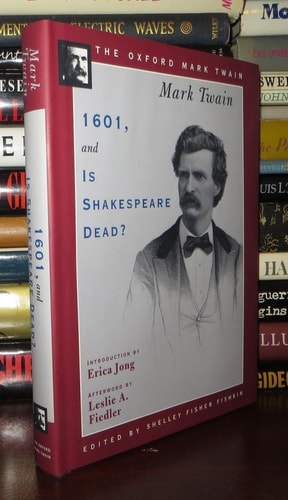
1601, or Conversation, as it was by the Social Fireside, in the time of the Tudors is a hilarious ribald send-up of Elizabethan England in which Queen Elizabeth, Shakespeare, Ben Jonson, Sir Walter Raleigh, and other luminaries of the period are pictured sitting about the fireplace amusing one another with risqué tales. During a visit to West Point in 1881, Twain met Lieutenant Charles Erskine Scott Wood, adjutant to the commanding general. As Leslie Fiedler notes in his afterword, "he discovered not only that Wood, like him, was a freethinker, but that he had at his disposal a well-equipped printing plant." He asked Wood to publish the piece, and it is the West Point edition--complete with the Old English-style type Wood selected--that is printed here.If "in 1601 Twain both parodied and paid homage to Shakespeare's liberating bawdry," Erica Jong observes in her introduction, in "Is Shakespeare Dead? he tried to come to terms with his conflicting responses to Shakespeare as mentor and muse." Jong suggests that Twain's real concern in this book may well be his own "place in literary history."
Menrva's Summary
THE PULSE
The central conflict involves a collision between the rigid, formal expectations of historical literary figures and the irreverent, bawdy reality of human conversation. In the fictionalized dialogue of 1601, Queen Elizabeth and her court engage in ribald storytelling that challenges the decorum of the Tudor era. The narrative framework shifts from this satirical play to a reflective, non-linear examination of authorship in Is Shakespeare Dead?, where Twain grapples with the weight of literary legacy. The protagonist, Twain himself, navigates the tension between his admiration for Shakespeare and his own desire for historical permanence.
INSIDE THE PAGES
- Use of archaic, Old English-style prose to mimic the Tudor period
- Satirical characterization of historical figures including Queen Elizabeth and Ben Jonson
- Explicit, ribald humor intended to subvert traditional historical portrayals
- Epistolary and conversational narrative structures
- Meta-fictional commentary on the nature of literary influence
- Exploration of the anxieties surrounding artistic immortality
- Contrast between high-brow literary reputation and low-brow human behavior
- Inclusion of historical context regarding the original West Point printing
THE COLLECTIVE ECHO
Readers and critics often discuss this volume as a dual-sided exploration of Mark Twain's complex relationship with the literary canon. Discussion frequently centers on the stark contrast between the crude, comedic energy of the 1601 dialogue and the more introspective, analytical tone of the accompanying essay. Scholars highlight how Twain uses these disparate forms to interrogate his own standing within the history of literature. The work is noted for its ability to balance genuine homage to Shakespeare with a biting, self-aware critique of the creative process. Readers often find the juxtaposition of these two pieces provides a unique window into the author's private intellectual struggles.
Page Count:
256
Publication Date:
1996-12-05
Publisher:
Oxford University Press
ISBN-10:
019510160X
ISBN-13:
9780195101607
Historical Fiction
Humor
Satire
Great Britain
Literary Criticism
Literature
Essays