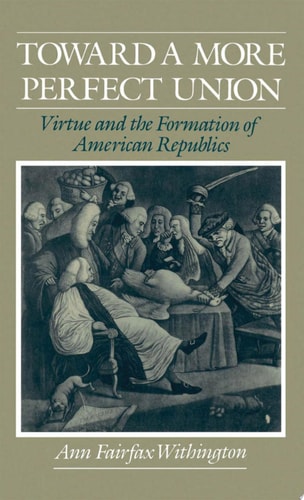
Toward a More Perfect Union: Virtue and the Formation of American Republics
0
0
As an Amazon Associate and affiliate partner, Menrva Books earns from qualifying purchases. Learn more
Author Description
In October of 1774, Congress passed a moral code which banned the theater, cock-fights, and horse races. In abiding by this code, Americans built for themselves a character as a virtuous people which set them apart from the "corrupt" British, prepared them to declare independence, and gave them the confidence to establish republican governments. This book uses the specific moral code of Congress as a springboard into the issues generated by the constitutional crisis that precipitated the American Revolution. Withington argues that the moral program, grounded in popular culture, worked as a political strategy to involve people emotionally in the cause and to broaden the reach of resistance to include all classes and both genders. Withington's integration of political history with the materials of popular culture, including cocker manuals, mortuary paraphernalia, prints, caricatures, anagrams, bawdy comedies and sentimental tragedies, and last speeches of condemned criminals leads the reader into a deeper understanding of the formation and significance of the revolutionary ideology
Menrva's Summary
THE THESIS
This book investigates how the Continental Congress utilized a specific moral code in 1774 to foster a distinct American identity and mobilize the populace for independence. Ann Fairfax Withington, a scholar of early American history, examines the intersection of political strategy and popular culture during the constitutional crisis preceding the American Revolution. She argues that by banning activities like theater and cock-fighting, the revolutionary leadership successfully cultivated a sense of civic virtue that unified diverse social classes and genders under a common political cause.
THE SCOPE MAP
What You Will Find
- Analysis of the 1774 Continental Congress moral code and its political implications.
- Examination of popular culture artifacts including prints, caricatures, and anagrams.
- Integration of social history with constitutional and political developments.
- Discussion of how moral reform functioned as a strategy for mass political engagement.
THE AUTHORITY PERSPECTIVE
Historians and scholars of the American Revolution frequently cite this work for its innovative approach to linking cultural artifacts with political ideology. The text is recognized for providing a nuanced perspective on how the revolutionary movement expanded its reach beyond the political elite to the broader public.
Page Count:
304
Publication Date:
1996-09-12
Publisher:
Oxford University Press
ISBN-10:
0195101308
ISBN-13:
9780195101300
History
Cultural History
Revolutionary War
American History
Community Tags
Similar Books














