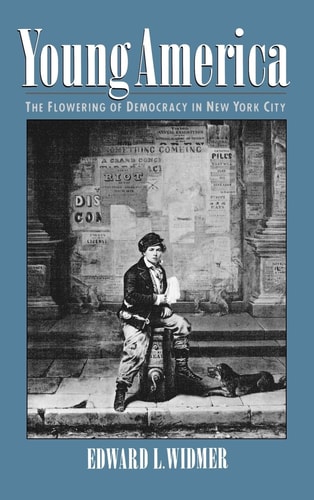
Young America: The Flowering of Democracy in New York City
0
0
As an Amazon Associate and affiliate partner, Menrva Books earns from qualifying purchases. Learn more
Author Description
This fascinating study examines the meteoric career of a vigorous intellectual movement rising out of the Age of Jackson. As Americans argued over their destiny in the decades preceding the Civil War, an outspoken new generation of "ultra-democratic" writers entered the fray, staking out positions on politics, literature, art, and any other territory they could annex. They called themselves Young America--and they proclaimed a "Manifest Destiny" to push back frontiers in every category of achievement. Their swagger found a natural home in New York City, already bursting at the seams and ready to take on the world.Young America's mouthpiece was the Democratic Review, a highly influential magazine funded by the Democratic Party and edited by the brash and charismatic John O'Sullivan. The Review offered a fresh voice in political journalism, and sponsored young writers like Hawthorne and Whitman early in their careers. Melville, too, was influenced by Young America, and provided a running commentary on its many excesses. Despite brilliant promise, the movement fell apart in the 1850s, leaving its original leaders troubled over the darker destiny they had ushered in. Their ambitious generation had failed to rewrite history as promised. Instead, their perpetual agitation helped set the stage for the Civil War.Young America: The Flowering of Democracy in New York City is without question the most complete examination of this captivating and original movement. It also provides the first published biography of its leader, John O'Sullivan, one of America's great rhetoricians. Edward L. Widmer enriches his unique volume by offering a new theory of Manifest Destiny as part of a broader movement of intellectual expansion in nineteenth-century America.
Menrva's Summary
THE THESIS
This book investigates the rise and fall of the Young America movement, a group of intellectuals who sought to redefine American identity and destiny during the pre-Civil War era. Edward L. Widmer, a historian and scholar, utilizes primary source materials from the Democratic Review and personal correspondence to analyze how this group of writers and politicians attempted to influence national policy. The author argues that their aggressive pursuit of expansionism and democratic reform, while intellectually vibrant, ultimately contributed to the political instability that precipitated the Civil War.
THE SCOPE MAP
What You Will Find
- An analysis of the intellectual climate in New York City during the Age of Jackson.
- A detailed biography of John O'Sullivan, the editor of the Democratic Review.
- Examination of the movement's influence on literary figures such as Nathaniel Hawthorne, Walt Whitman, and Herman Melville.
- A new theoretical framework connecting the concept of Manifest Destiny to broader nineteenth-century intellectual expansion.
THE AUTHORITY PERSPECTIVE
Historians and scholars of nineteenth-century American culture frequently cite this work as a definitive study of the Young America movement. The text is recognized for its rigorous archival research and its ability to synthesize complex political and literary history into a coherent narrative.
Page Count:
300
Publication Date:
1998-11-19
Publisher:
Oxford University Press
ISBN-10:
0195100506
ISBN-13:
9780195100501
History
Biography
American History
New York
Nineteenth century
Intellectual History
Political Activity
Democracy history
Community Tags
Similar Books














