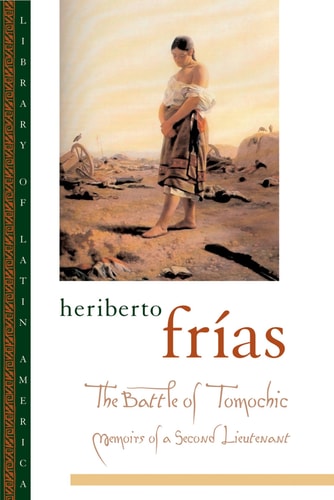
The Battle of Tomochic: Memoirs of a Second Lieutenant
0
0
As an Amazon Associate and affiliate partner, Menrva Books earns from qualifying purchases. Learn more
Author Description
Tomochic is a controversial and celebrated example of Mexican fiction. Tomochic is the fictional narration of the 1892 military campaign that resulted in the massacre of the small village of Tomochic, located in the Tarahumara mountains and ordered by the dictatorial regime of Porfirio Díaz. The work is narrated by an eyewitness, the then second lieutenant, Heriberto Frías, and written by him in collaboration with Joaquin Clausell, editor of the newspaper which published it in serial form between March and April of 1893. For a period after the series' publication, the author chose to maintain anonymity. It was expressly this stance which excited more public interest than any other Mexican writer of the 19th century and which eventually led to a drawn out trial to uncover the identity of the author and to implicate him. For, although it is a work of fiction, the general plot of the work, involving a confrontation between a professional army and a handful of citizens, was too similar to the actual massacre as to not be seen by Porfirio Díaz as a reprovement of himself and his regime. As a piece of literature, the novel is also admired for its incorporation of two important trends of the nineteenth century-history as literature and the war novel.
Menrva's Summary
THE PULSE
The narrative centers on the brutal 1892 military campaign against the village of Tomochic, exposing the violent friction between a dictatorial regime and a defiant citizenry. The protagonist, a second lieutenant serving in the Mexican army, observes the systematic destruction of the Tarahumara mountain community under the orders of Porfirio Díaz. Through a first-person perspective, the text documents the moral erosion of the soldiers and the tragic futility of the conflict. The narrative framework functions as a semi-autobiographical account, blending the immediacy of eyewitness testimony with the structural constraints of a serialized newspaper novel.
INSIDE THE PAGES
- First-person perspective from the viewpoint of a military officer
- Realistic depiction of 19th-century military campaign logistics
- Exploration of the conflict between state authority and local autonomy
- Serialized narrative structure originally published in 1893
- Integration of historical events with fictionalized character arcs
- Critical examination of the Porfirio Díaz regime
- Atmospheric setting within the rugged Tarahumara mountains
- Focus on the psychological toll of state-sanctioned violence
THE COLLECTIVE ECHO
Readers and critics frequently highlight the work as a foundational example of Mexican realism that bridges the gap between historical record and narrative art. Discussion often centers on the author's courageous decision to publish anonymously, which transformed the book into a political lightning rod during the late 19th century. Scholars note that the pacing reflects the urgency of its original serialized format, maintaining a tension that mirrors the real-world massacre it depicts. The text is widely recognized for its ability to critique authoritarian power structures while maintaining a grounded, visceral portrayal of war. Readers often appreciate how the novel serves as both a gripping story and a significant historical document regarding the Porfirio Díaz era.
Page Count:
208
Publication Date:
2006-09-14
Publisher:
Oxford University Press
ISBN-10:
0195117433
ISBN-13:
9780195117431
Historical Fiction
English
War
Mexican
English & College Success
Realism
Mexico fiction
Political fiction
Community Tags
Similar Books