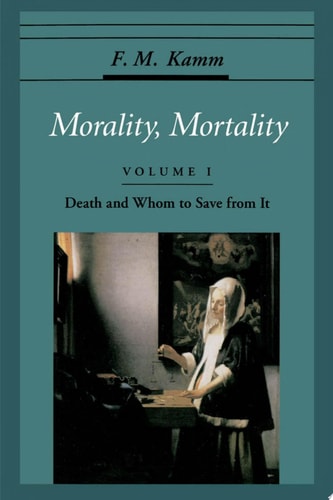
Morality, Mortality: Volume I: Death and Whom to Save from It
0
0
As an Amazon Associate and affiliate partner, Menrva Books earns from qualifying purchases. Learn more
Author Description
Why is death bad for us, even on the assumption that it involves the absence of experience? Is it worse for us than prenatal nonexistence? Kamm begins by considering these questions, critically examining some answers other philosophers have given. She explores in detail suggestions based on our greater concern over the loss of future versus past goods and those based on the insult to persons which death involves. In the second part, Kamm deals with the question, "Whom should we save from death if we cannot save everyone?" She considers whether and when the numbers of lives we can save matter in our choice, and whether the extra good we achieve if we save some lives rather than others should play a role in deciding whom to save. Issues such as fairness, solidarity, the role of random decision procedures, and the relation between subjective and objective points of view are discussed, with an eye to properly incorporating these into a nonconsequentialist ethical theory. In conclusion, the book examines specifically what differences between persons are relevant to the distribution of any scarce resource, discussing for example, the distribution (and acquisition) of bodily organs for transplantation. Kamm provides criticism of some current procedures for distribution and acquisition of a scarce resource and makes suggestions for alternatives.
Menrva's Summary
THE THESIS
This work investigates the philosophical foundations of death's moral significance and the ethical criteria for prioritizing life-saving interventions when resources are limited. F. M. Kamm, a prominent philosopher specializing in normative ethics, utilizes a rigorous analytical framework to evaluate the nature of death and the principles governing the distribution of scarce life-saving resources. By contrasting subjective and objective viewpoints, she constructs a nonconsequentialist theory that addresses the complexities of fairness, solidarity, and individual value in medical decision-making.
THE SCOPE MAP
What You Will Find
- Philosophical analysis of why death is considered a harm to the individual.
- Evaluation of the moral weight of numbers in life-saving scenarios.
- Examination of fairness and random decision procedures in resource allocation.
- Application of ethical theory to the distribution and acquisition of organs for transplantation.
THE AUTHORITY PERSPECTIVE
Experts recognize this text as a significant contribution to contemporary bioethics and moral philosophy. Readers frequently note the high level of academic density and the meticulous logical structure Kamm employs to challenge standard consequentialist assumptions.
Page Count:
352
Publication Date:
1998-05-07
Publisher:
Oxford University Press
ISBN-10:
0195119118
ISBN-13:
9780195119114
Non-Fiction
Philosophy
Death
Euthanasia
Bioethics
Ethics
Medical Ethics
Terminal Care
Community Tags
Similar Books