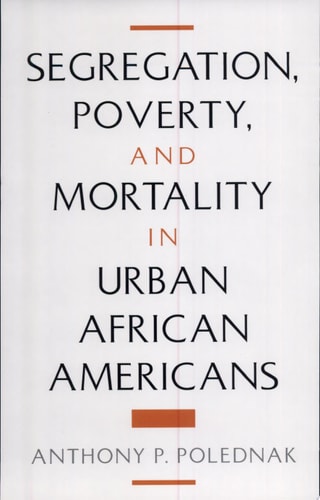
Segregation, Poverty, and Mortality in Urban African Americans
0
0
As an Amazon Associate and affiliate partner, Menrva Books earns from qualifying purchases. Learn more
Author Description
The potential impact of segregation on the health of African-Americans is an intriguing and controversial topic that draws from the areas of epidemiology and the social sciences. Epidemiologists have recently turned to the study of racism and health, but epidemiologic studies have not dealt specifically with black-white segregation and health. This book examines mortality rates for African-Americans in selected U.S. urban areas in relation to both social class and the degree of black-white residential segregation. Despite allowances for economic disparity, mortality rates for African-American infants and young adults are shown to be especially high in certain highly-segregated areas--a traditional indicator of low levels of social progress.Polednak includes previously unpublished analyses of the findings along with data from prior calendar years and the 1990 U.S. census. He uses the statistical method (multiple linear regression) to analyze poverty rates and levels of segregation amongst African-Americans. The author's discussion of social and health issues fits within the framework of Swedish economist Gunnar Myrdal's "American dilemma" thesis that the American creed of egalitarianism, equal opportunity and freedom from discrimination remains unfulfilled. The conclusions are expected to foster interest, on behalf of both epidemiologists and sociologists, in what may be termed the "epidemiology of American apartheid"--a specialized field of research with concrete relevance to social and health policy.Beside the book's primary audience--epidemiologists and public health practitioners--this volume is intended to appeal to sociologists, especially medical sociologists, who are likely to be familiar with segregation but not with its potential relevance to the health of African-Americans. Psychologists interested in racial discrimination are important potential collaborators with sociologists and epidemiologists in studies of the epidemiology of racial difference in health.
Menrva's Summary
THE THESIS
This book investigates the correlation between residential segregation, socioeconomic status, and mortality rates among African Americans in urban U.S. environments. Anthony P. Polednak, an expert in public health and epidemiology, utilizes 1990 U.S. census data and historical records to test the hypothesis that structural segregation independently influences health outcomes. By applying multiple linear regression, he frames his findings within Gunnar Myrdal’s 'American dilemma' thesis, arguing that systemic inequality continues to undermine the health of marginalized populations.
THE SCOPE MAP
What You Will Find
- Statistical analysis of mortality rates for African American infants and young adults in highly segregated urban centers.
- Application of multiple linear regression to isolate the effects of poverty versus residential segregation.
- Integration of Gunnar Myrdal’s social theory with contemporary epidemiological data.
- Examination of the 'epidemiology of American apartheid' as a framework for future health policy research.
THE AUTHORITY PERSPECTIVE
Experts and public health practitioners identify this work as a foundational text for understanding the intersection of structural racism and health disparities. Readers frequently note the technical density of the statistical analysis, which serves as a rigorous resource for researchers in sociology and epidemiology.
Page Count:
192
Publication Date:
1997-02-13
Publisher:
Oxford University Press
ISBN-10:
0195111656
ISBN-13:
9780195111651
Urban Studies
Public Health
Sociology
Social Science
African Americans
Epidemiology
Community Tags
Similar Books