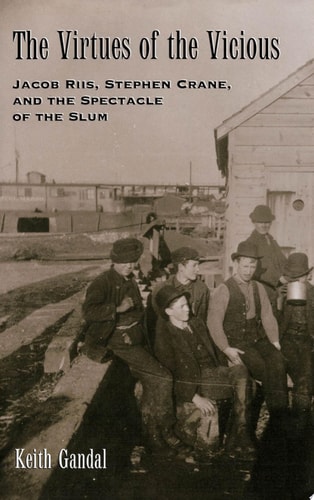
The Virtues of the Vicious: Jacob Riis, Stephen Crane and the Spectacle of the Slum
0
0
As an Amazon Associate and affiliate partner, Menrva Books earns from qualifying purchases. Learn more
Author Description
In this compelling work, Keith Gandal reveals how the slum in nineteenth-century America, long a topic for sober moral analysis, became in the 1890s an unprecedented source of spectacle, captured in novels, newspapers, documentary accounts, and photographs. Reflecting a change in the middle-class vision of the poor, the slum no longer drew attention simply as a problem of social conditions and vice but emerged as a subject for aesthetic, ethnographic, and psychological description. From this period dates the fascination with the "colorful" alternative customs and ethics of slum residents, and an emphasis on nurturing their self-esteem. Middle-class portrayals of slum life as "strange and dangerous" formed part of a broad turn-of-the-century quest for masculinity, Gandal argues, a response to a sentimental Victorian respectability perceived as stifling. These changes in middle-class styles for representing the urban poor signalled a transformation in middle- class ethics and a reconception of subjectivity.Developing a broad cultural context for the 1890s interest in the poor, Gandal also offers close, groundbreaking analysis of two of the period's crucial texts. Looking at Jacob Riis's How the Other Half Lives (1890), Gandal documents how Riis's use of ethnographic and psychological details challenged traditional moralist accounts and helped to invent a spectacular style of documentation that still frames our approach as well as our solutions to urban problems. Stephen Crane's Maggie: A Girl of the Streets (1893) pushed ethnographic and psychological analysis even farther, representing a human interiority centered around self-image as opposed to character and exploring not only different customs but a radically different ethics in New York's Bowery--what we would call today a "culture of poverty." Gandal meanwhile demonstrates how both Riis's innovative "touristic" approach and Crane's "bohemianism" bespeak a romanticization of slum life and an emerging middle-class
Menrva's Summary
THE THESIS
How did the representation of the American slum shift from a site of moral condemnation to a spectacle of aesthetic and psychological interest during the 1890s? Keith Gandal, a scholar of American literature and culture, examines the intersection of middle-class identity formation and the documentation of urban poverty. He argues that the turn-of-the-century fascination with the 'vicious' slum was a strategic response to the perceived stifling nature of Victorian respectability, leading to a new, romanticized mode of ethnographic observation.
THE SCOPE MAP
What You Will Find
- Analysis of the 1890s transition in middle-class attitudes toward urban poverty and the 'culture of poverty' concept.
- Examination of Jacob Riis's 'How the Other Half Lives' as a foundational text for spectacular urban documentation.
- Investigation of Stephen Crane's 'Maggie: A Girl of the Streets' as a study in human interiority and self-image.
- Exploration of the relationship between the quest for masculinity and the aestheticization of the Bowery.
THE AUTHORITY PERSPECTIVE
Scholars frequently cite this work for its nuanced analysis of how literary and documentary styles influence social policy and public perception. Experts highlight the text as a significant contribution to understanding the historical roots of modern urban ethnographic practices.
Page Count:
206
Publication Date:
1997-10-23
Publisher:
Oxford University Press
ISBN-10:
0195110633
ISBN-13:
9780195110630
History
American Studies
Cultural History
American History
Sociology
Criticism history
English & College Success
English
Urban Studies
Slums
Literary Criticism
Community Tags
Similar Books














