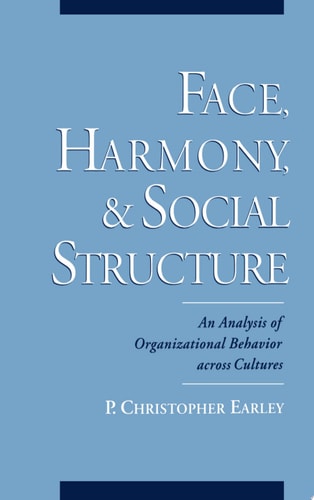
Face, Harmony, and Social Structure: An Analysis of Organizational Behavior Across Cultures
0
0
As an Amazon Associate and affiliate partner, Menrva Books earns from qualifying purchases. Learn more
Author Description
Face, Harmony, and Social Structure continues author P. Christopher Earley's investigations of the differences among people within organizations in different cultures. The concept of "face," as set forth by Earley, is a reflection of the individual's struggle for self-definition and understanding, of which a key component is a positioning of self relative to others is a social setting. Face is at the heart of social behavior and provides a consistent linking mechanism to understand behavior across cultures.Earley uses this concept of face as a basis for examination of cross-cultural organizational behavior from an individual's personal perspective. In this work, he develops a mid-range theory of individual behavior, self-concept, and interpersonal process in an effort to explain cultural differences in organizational settings. He sets up a cross-level model, and then attempts to provide a single coherent force--"face"--as an engine driving the entire system that can be used to integrate various social and organizational mechanisms in predicting people's behavior. This understanding of how and why people behave certain ways is a critical tool for studying the impact of individual behavior on the functioning of organizations.Earley's work represents a new theory of self-presentation and face within a cross-cultural context, integrating a cross-level approach ranging from the individual to the organization and to the societal levels of discussion. Face, Harmony, and Social Structure is a truly interdisciplinary work that brings elements of psychology, sociology, and anthropology to organizational studies. It will be illuminating reading for professionals and scholars of management and organizational behavior, as well as to academics in cross-cultural psychology and anthropology.
Menrva's Summary
THE THESIS
How does the concept of 'face' serve as a foundational mechanism for understanding and predicting individual behavior within diverse organizational and cultural structures? P. Christopher Earley, an expert in cross-cultural organizational behavior, utilizes his extensive research to propose a mid-range theory of self-concept and interpersonal processes. By establishing a cross-level model, Earley argues that the pursuit of face acts as a primary engine driving social behavior, allowing for a more integrated analysis of how individuals navigate organizational settings across different societies.
THE SCOPE MAP
What You Will Find
- A cross-level theoretical framework connecting individual self-concept to organizational and societal structures.
- A comprehensive analysis of 'face' as a consistent linking mechanism for cross-cultural social behavior.
- An interdisciplinary methodology synthesizing principles from psychology, sociology, and anthropology.
- Predictive models for understanding individual behavior and interpersonal processes within global management contexts.
THE AUTHORITY PERSPECTIVE
Scholars and professionals in management and cross-cultural studies recognize this work as a significant contribution to the theoretical understanding of organizational behavior. Readers frequently note the academic density of the prose, which serves as a foundational text for those examining the intersection of cultural identity and professional performance.
Page Count:
256
Publication Date:
1997-09-04
Publisher:
Oxford University Press
ISBN-10:
0195110072
ISBN-13:
9780195110074
Psychology
Anthropology
Sociology
Management
Community Tags
Similar Books