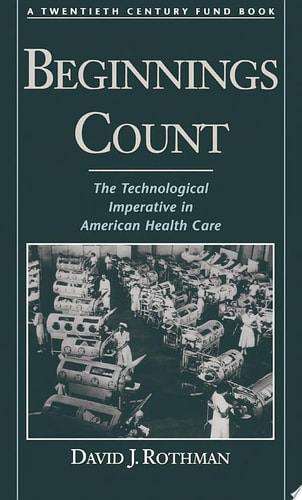
Beginnings Count: The Technological Imperative in American Health Care
0
0
As an Amazon Associate and affiliate partner, Menrva Books earns from qualifying purchases. Learn more
Author Description
In the wake of the recent unsuccessful drive for health care reform, many people have been asking themselves what brought about the failure of this as well as past attempts to make health care accessible to all Americans. The author of this original exploration of U.S. health policy supplies an answer that is bound to raise some eyebrows. After a careful analysis of the history and issues of health care, David Rothman concludes that it is the average employed, insured "middle class"--the vaguely defined majority of American citizens--who deny health care to the poor.The author advances his argument through the examination of two distinctive characteristics of American health care and the intricate links between them: the ubiquitous presence of technology in medicine, and the fact that the U.S. lacks a national health insurance program. Technology bears the heaviest responsibility for the costliness of American medicine. Rothman traces the histories of the "iron lung" and kidney dialysis machines in order to provide vivid evidence for his claim that the American middle class is fascinated by technology and is willing to pay the price to see the most recent advances in physics, biology, and biomedical engineering incorporated immediately in medical care. On the other hand, the lack of a universal health insurance program in the U.S. is rooted in the fact that, starting in the 1930s, government health policy has been a reflection of the needs and concerns of the middle class. Playing up to middle class sensibilities, the American presidents, Senate and Congress based their policy upon the private rather than the public sector, whenever possible. They encouraged the purchase of insurance based on the laws of the marketplace, not provided by the government. Private health insurance and high-tech medicine came with a hefty price, with the end result that about 40 million Americans could not afford medical care and were left to fend for themselves. The author investigates
Menrva's Summary
THE THESIS
Does the American middle class's preoccupation with high-tech medical innovation fundamentally obstruct the establishment of universal health care? David J. Rothman, a historian of medicine and society, examines the intersection of technological advancement and private insurance policy in the United States. He argues that the middle class's demand for immediate access to cutting-edge medical technology has incentivized a market-based insurance system that systematically excludes the poor. By tracing the evolution of health policy since the 1930s, Rothman demonstrates how political decisions have consistently prioritized private sector interests over public health equity.
THE SCOPE MAP
What You Will Find
- Historical analysis of the development and adoption of the iron lung and kidney dialysis machines.
- Examination of the political and economic factors that led to the dominance of private health insurance over universal coverage.
- Case studies illustrating the impact of technological costs on the accessibility of medical services.
- A critique of how middle-class sensibilities have shaped American legislative priorities in health care.
THE AUTHORITY PERSPECTIVE
Experts recognize this work as a critical historical analysis of the structural barriers to universal health care in the United States. Readers frequently note the clarity with which Rothman connects technological enthusiasm to the broader failure of American health policy.
Page Count:
189
Publication Date:
1997-01-15
Publisher:
Oxford University Press
ISBN-10:
0195111184
ISBN-13:
9780195111187
History
Medicine
Health Policy
Public Health
American History
Medical policy
Health insurance
Sociology
Community Tags
Similar Books