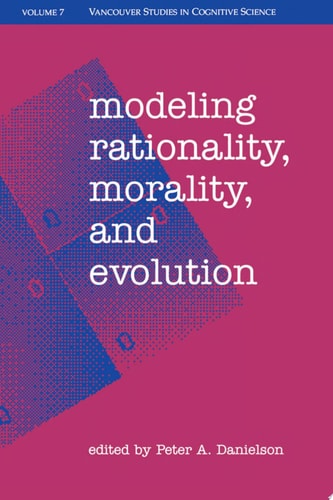
Modelling Rationality, Morality, and Evolution
0
0
As an Amazon Associate and affiliate partner, Menrva Books earns from qualifying purchases. Learn more
Author Description
This collection focuses on questions that arise when morality is considered from the perspective of recent work on rational choice and evolution. Linking questions like "Is it rational to be moral?" to the evolution of cooperation in "The Prisoners Dilemma," the book brings together new work using models from game theory, evolutionary biology, and cognitive science, as well as from philosophical analysis. Among the contributors are leading figures in these fields, including David Gauthier, Paul M. Churchland, Brian Skyrms, Ronald de Sousa, and Elliot Sober.
Menrva's Summary
THE THESIS
This collection investigates the intersection of rational choice theory, evolutionary biology, and moral philosophy to determine if moral behavior can be reconciled with individual rationality. Peter A. Danielson compiles interdisciplinary research to examine how cooperation emerges and persists within competitive frameworks. By utilizing game theory models and cognitive science, the contributors analyze the evolutionary mechanisms that support altruistic or moral decision-making in human agents. The volume serves as a bridge between formal mathematical modeling and traditional ethical inquiry.
THE SCOPE MAP
What You Will Find
- Game theory applications, specifically the Prisoner's Dilemma, to model cooperative behavior.
- Evolutionary biology frameworks explaining the development of moral traits.
- Philosophical analysis regarding the rationality of moral commitments.
- Cognitive science perspectives on decision-making processes and social interaction.
THE AUTHORITY PERSPECTIVE
Experts recognize this volume as a significant contribution to the formalization of moral philosophy through the lens of evolutionary game theory. Readers frequently note the academic density of the prose, which requires a foundational understanding of both philosophical ethics and mathematical modeling to fully grasp the arguments presented.
Page Count:
480
Publication Date:
1999-01-07
Publisher:
Oxford University Press
ISBN-10:
0195125495
ISBN-13:
9780195125498
Philosophy
Ethics
Game theory
Rational choice theory
Evolutionary Biology
Community Tags
Similar Books