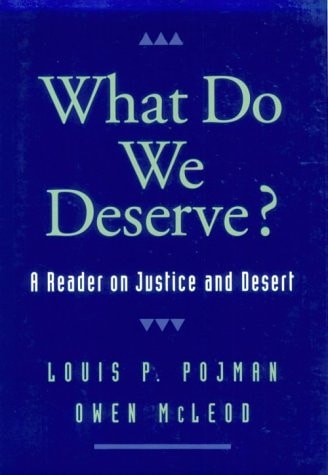
What Do We Deserve?: A Reader on Justice and Desert
0
0
As an Amazon Associate and affiliate partner, Menrva Books earns from qualifying purchases. Learn more
Author Description
The concept of desert, which once enjoyed a central place in political and ethical theory, has been relegated to the margins of much of contemporary theory, if not excluded altogether. Recently a renewed interest in the topic has emerged, and several philosophers have argued that the notion merits a more central place in political and ethical theory. Some of these philosophers contend that justice exists to the extent that people receive exactly what they deserve, while others argue that desert should replace such considerations as rights, need, and equality as the basis for distributions. Still others argue that morality involves a fitting match between one's moral character and a degree of happiness. All of these positions have encountered opposition from egalitarians, libertarians, and those who are skeptical about the coherence of the concept of desert. The first anthology of its kind, What Do We Deserve? is a balanced collection of readings that brings sharply opposing positions and arguments together and stimulates debate over the meaning and significance of desert in current thought. The book begins with eight classical readings on desert (by Plato, Aristotle, Hobbes, Smith, Kant, Mill, Sidgwick, and Ross), and later turns to contemporary interpretations of the issue. The selections examine the concept itself, analyze its relationship to the ideas of freedom and responsibility, engage in the debate between John Rawls and his critics on the merits of desert, and, finally, study the wider role and significance of desert in political and ethical theory.
Menrva's Summary
THE THESIS
This anthology investigates the philosophical validity and practical application of desert as a foundational principle for justice and ethical distribution. Louis P. Pojman and Owen McLeod, both established scholars in the field of ethics, curate a comprehensive selection of texts to address the historical neglect of desert in contemporary theory. The volume argues that the concept of desert—the idea that individuals should receive what they are owed based on their actions or character—demands a central role in modern political discourse, despite significant opposition from egalitarian and libertarian frameworks.
THE SCOPE MAP
What You Will Find
- A chronological survey of classical philosophical perspectives on desert from thinkers including Plato, Aristotle, Hobbes, and Kant.
- Contemporary debates regarding the tension between desert and competing values such as need, equality, and individual rights.
- Critical analysis of the intersection between moral character, personal responsibility, and the distribution of social goods.
- A focused examination of the discourse surrounding John Rawls and his critics regarding the legitimacy of desert-based justice.
THE AUTHORITY PERSPECTIVE
Experts identify this collection as a foundational resource for students and scholars navigating the complex intersection of ethics and political philosophy. Readers frequently note the academic density of the prose, which serves as a rigorous introduction to the primary arguments surrounding distributive justice.
Page Count:
336
Publication Date:
1998-09-24
Publisher:
Oxford University Press
ISBN-10:
0195122178
ISBN-13:
9780195122176
Non-Fiction
Philosophy
Ethics
Social justice
Community Tags
Similar Books