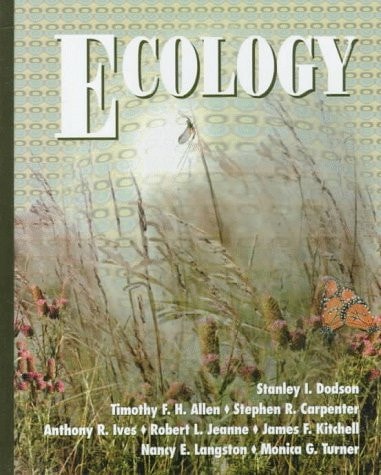
Ecology
0
0
As an Amazon Associate and affiliate partner, Menrva Books earns from qualifying purchases. Learn more
Author Description
Complex and diverse, modern ecology is often difficult to introduce to undergraduate students in a way that conveys the excitement and enthusiasm that ecologists feel for their field. In this text, the authors aim to encourage students by adopting a new approach to teaching modern ecology, dividing the field into several distinct subdisciplines, each with its own way of looking at the world...Unique and accessible, Ecology concentrates on the ideas and techniques that separate different concept-based approaches to the study of ecology. It discusses six kinds of ecology: landscape, physiological, ecosystem, population, community, and behavioral, focusing on the kinds of questions ecologists ask about their world rather than on accumulated ecological knowledge. For each type of ecology, the authors explore how it is distinct, the theory and technology involved, and its successes and possibilities for the future. Each chapter discusses the roles of evolution and of modeling in that particular kind of ecology, and also emphasizes that there are important questions ecologists do not yet have the answers to. These questions encourage students to consider pursuing the study of ecology because there is still much significant work to be done. The authors, all experts in specific areas of ecology, strive to inspire students by communicating the excitement they feel about their respective fields of study and by actively involving students in the learning process. The discussions are set in the context of the human relationship to nature and include practical applications of ecology, such as resource management and conservation.Easily accessible to undergraduate students in general ecology, this brief, up-to-date, and lucidly written text is an ideal starting place for learning ecology. It sets ecology in its cultural context and encourages students to see ecology happening all around them, opening their eyes to the wide range of possibilities in the field and providing them wi
Menrva's Summary
THE THESIS
This text investigates how the diverse subdisciplines of modern ecology can be structured to provide undergraduate students with a cohesive and engaging introduction to the field. The authors, a collaborative group of experts in various ecological specialties, argue that focusing on the specific questions and methodologies unique to different branches of ecology—rather than merely presenting a static body of knowledge—better prepares students for scientific inquiry. By framing the study around six distinct subdisciplines, the book provides a conceptual roadmap that highlights both current theoretical frameworks and the unresolved questions that define the future of the discipline.
THE SCOPE MAP
What You Will Find
- A conceptual breakdown of six distinct ecological subdisciplines: landscape, physiological, ecosystem, population, community, and behavioral ecology.
- An examination of the role of evolution and mathematical modeling within each specific ecological approach.
- Integration of human-nature relationships, including practical applications in resource management and conservation.
- A pedagogical focus on the scientific process, emphasizing the questions ecologists ask and the techniques they employ to seek answers.
THE AUTHORITY PERSPECTIVE
Educators frequently cite this text as a successful departure from encyclopedic survey books, noting its effectiveness in teaching students how to think like ecologists. The prose is widely regarded as accessible and lucid, making it a standard introductory resource for undergraduate biology and environmental science curricula.
Page Count:
464
Publication Date:
1998-03-26
Publisher:
Oxford University Press
ISBN-10:
0195120795
ISBN-13:
9780195120790
Science
Education
textbook
Biology
Ecology
Community Tags
Similar Books





Reader Comments
Share Your Thoughts
No comments yet. Be the first to share your thoughts!