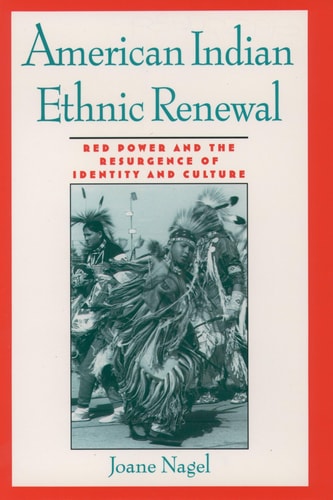
American Indian Ethnic Renewal: Red Power and the Resurgence of Identity and Culture
0
0
As an Amazon Associate and affiliate partner, Menrva Books earns from qualifying purchases. Learn more
Author Description
Does activism matter? This book answers with a clear "yes." American Indian Ethnic Renewal traces the growth of the American Indian population over the past forty years, when the number of Native Americans grew from fewer than one-half million in 1950 to nearly 2 million in 1990. This quadrupling of the American Indian population cannot be explained by rising birth rates, declining death rates, or immigration. Instead, the growth in the number of American Indians is the result of an increased willingness of Americans to identify themselves as Indians. What is driving this increased ethnic identification? In American Indian Ethnic Renewal, Joane Nagel identifies several historical forces which have converged to create an urban Indian population base, a reservation and urban Indian organizational infrastructure, and a broad cultural climate of ethnic pride and militancy. Central among these forces was federal Indian "Termination" policy which, ironically, was designed to assimilate and de-tribalize Native America. Reactions against Termination were nurtured by the Civil Rights era atmosphere of ethnic pride to become a central focus of the native rights activist movement known as "Red Power." This resurgence of American Indian ethnic pride inspired increased Indian ethnic identification, launched a renaissance in American Indian culture, language, art, and spirituality, and eventually contributed to the replacement of Termination with new federal policies affirming tribal Self- Determination. American Indian Ethnic Renewal offers a general theory of ethnic resurgence which stresses both structure and agency--the role of politics and the importance of collective and individual action--in understanding how ethnic groups revitalize and reinvent themselves. Scholars and students of American Indians, social movements and activism, and recent United States history, as well as the general reader interested in Native American life, will all find this an engaging and informati
Menrva's Summary
THE THESIS
This book investigates the sociological and political drivers behind the significant increase in American Indian ethnic identification during the latter half of the twentieth century. Joane Nagel, a sociologist specializing in ethnic identity and social movements, utilizes demographic data and historical analysis to argue that this resurgence was not a result of biological growth, but rather a response to federal policy and the broader cultural climate of the Civil Rights era. She presents a framework that balances structural political forces with the agency of individuals and organizations in the process of ethnic revitalization.
THE SCOPE MAP
What You Will Find
- Demographic analysis of the American Indian population growth between 1950 and 1990
- Examination of federal Indian Termination policy and its unintended consequences
- Analysis of the Red Power movement as a catalyst for cultural and political resurgence
- A theoretical model for understanding ethnic identity construction and collective action
THE AUTHORITY PERSPECTIVE
Scholars and students of sociology and American Indian history frequently cite this work as a foundational text for understanding the intersection of federal policy and ethnic identity. Readers note the clarity of the author's sociological framework and the effectiveness of her analysis regarding the impact of social movements on individual self-identification.
Page Count:
320
Publication Date:
1997-09-25
Publisher:
Oxford University Press
ISBN-10:
0195120639
ISBN-13:
9780195120639
History
North America
Ethnic Studies
Sociology
Community Tags
Similar Books