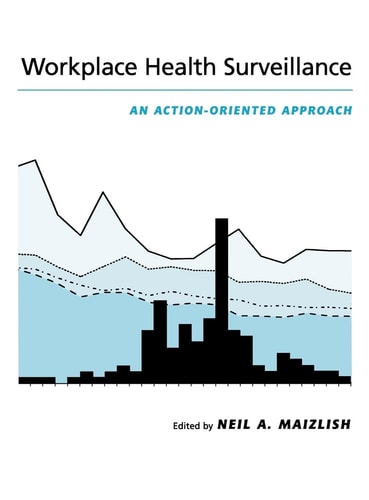
Workplace Health Surveillance: An Action-Oriented Approach
0
0
As an Amazon Associate and affiliate partner, Menrva Books earns from qualifying purchases. Learn more
Author Description
This is the first textbook that makes workplace health surveillance accessible to a broad audience. Step-by-step, it shows how to establish or improve a surveillance system. The reader learns about defining objectives, seeking organizational support, forming a surveillance workgroup, collecting data, calculating basic injury and illness statistics, designing databases, analyzing and interpreting surveillance data, setting priorities, making protocols for follow-up and case management, marketing results and giving feedback, and evaluating surveillance systems. Links are emphasized between surveillance and workplace follow-up, community-based intervention programs, cost-benefit analysis, and other prevention activities. Readers get a solid foundation of epidemiologic concepts reinforced by examples that use simple arithmetic. Leading practitioners from government, business, and unions illustrate the surveillance of injuries, lead poisoning, pesticide illness, cumulative trauma disorders, asthma, noise-induced hearing loss, silicosis, cancer, and chemical and physical hazards. Non-traditional data sources are examined, including health and disability insurance, hospital discharge, and poison control centers. Disability surveillance, return-to-work, and the quality/effectiveness of health services also are explored. Surveillance is shown to be an action-oriented tool for decision-making that is the key to a successful health and safety program.
Menrva's Summary
THE THESIS
This text investigates how to effectively implement and manage workplace health surveillance systems to improve safety outcomes. Author Neil A. Maizlish provides a structured, action-oriented framework designed to make complex epidemiologic concepts accessible to practitioners across government, business, and labor sectors. By integrating data collection, statistical analysis, and intervention strategies, the book argues that surveillance is a critical tool for informed decision-making and injury prevention.
THE SCOPE MAP
What You Will Find
- Methodologies for establishing and improving organizational health surveillance systems.
- Practical guides for calculating injury and illness statistics using basic arithmetic.
- Case studies covering diverse hazards including lead poisoning, cumulative trauma, and chemical exposure.
- Integration strategies linking surveillance data to cost-benefit analysis and community-based prevention programs.
THE AUTHORITY PERSPECTIVE
Experts recognize this work as a foundational textbook that bridges the gap between theoretical epidemiology and practical workplace application. Readers frequently note the clarity of the instructions and the utility of the real-world examples provided by practitioners from various sectors.
Page Count:
350
Publication Date:
2000-10-15
Publisher:
Oxford University Press
ISBN-10:
0195128885
ISBN-13:
9780195128888
Workplace Safety
Epidemiology
Health Surveys
Public Health
Occupational Health