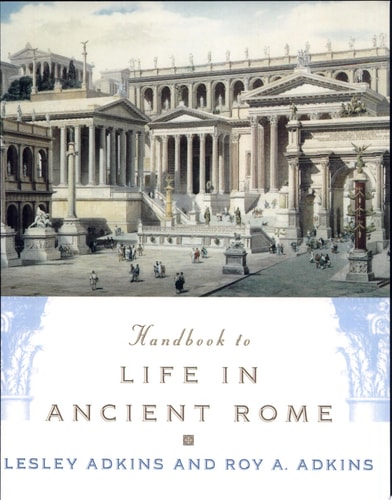
Handbook to Life in Ancient Rome
0
0
As an Amazon Associate and affiliate partner, Menrva Books earns from qualifying purchases. Learn more
Author Description
The rise and fall of the Roman Empire remains a crucial event in the history of Europe and the Near East, yet many reference sources either omit important facts and figures about the period or take them for granted. Now, Handbook to Life in Ancient Rome provides full access to the 1,200 years of Roman rule from the 8th century B.C. to the 5th century A.D., including information that is often hard to find and even harder to decipher. Organized thematically, nine chapters provide in-depth analysis of all aspects of Roman life, the Republic and the Empire, military affairs, geography of the Roman world, towns and countryside, travel and trade, literature and the arts, religion, economy and industry and everyday life. The myriad topics covered include rulers; the legal and governmental system; architectural feats such as the famous Roman roads and aqueducts, Hadrian's Wall and the Colosseum; the Roman system of names; coinage, weights and measures; even typical Roman leisure pursuits. Each chapter includes an extensive bibliography as well as site-specific photographs and line drawings, more than 125 in all. Maps chart the expansion and contraction of the territory from the foundation of the city of Rome itself to the Byzantine Empire and the ultimate decline of the West. Clear, authoritative and highly organized, Handbook to Life in Ancient Rome provides a unique look at a civilization whose art, literature, law and engineering influenced the whole of Western Europe throughout the Middle Ages, the Renaissance and beyond.
Menrva's Summary
THE THESIS
This handbook investigates the comprehensive social, political, and material structures that defined Roman civilization across its twelve-century duration. Authors Lesley and Roy A. Adkins, both experienced archaeologists and historians, synthesize vast amounts of archaeological data and historical records to provide a structured reference for the Roman world. The text argues that understanding the granular details of daily life, governance, and infrastructure is essential to grasping the broader trajectory of the Roman Empire from its inception to its eventual decline.
THE SCOPE MAP
What You Will Find
- A thematic analysis covering nine distinct areas including military affairs, economy, religion, and literature.
- Detailed examination of Roman infrastructure, specifically aqueducts, road networks, and monumental architecture.
- Primary source-based data on Roman naming conventions, coinage, and systems of measurement.
- Visual documentation including over 125 site-specific photographs, line drawings, and historical maps.
THE AUTHORITY PERSPECTIVE
Scholars and students frequently cite this work as a foundational reference tool due to its clear, thematic organization and accessibility. Experts highlight the text for its ability to bridge the gap between academic archaeological research and general historical interest.
Page Count:
416
Publication Date:
1998-07-16
Publisher:
Oxford University Press
ISBN-10:
0195123328
ISBN-13:
9780195123326
History
Heads Of State
Archaeology
Civilization
Rome
Roman Empire
Reference
Ancient History
Community Tags
Other Editions(3)
Similar Books



Reader Comments
Share Your Thoughts
No comments yet. Be the first to share your thoughts!