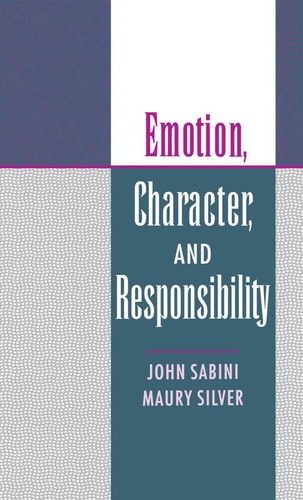
Emotion, Character and Responsibility: Responsibility and Aesthetics in the Discovery of Character
0
0
As an Amazon Associate and affiliate partner, Menrva Books earns from qualifying purchases. Learn more
Author Description
In their new book, Emotion, Character, and Responsibility, John Sabini and Maury Silver examine a conflict in the way that psychologists, philosophers, and ordinary people think about character. Most of us share an intuition that emotions are central to who we are and the characters we have, even though emotions are unchosen. Yet we also share the intuition that action, choice, and responsibility are what count about our characters. This book deals with this conflict by exploring the relations between the chosen and unchosen, moral and nonmoral, in sincerity, loyalty, sympathy, shame, guilt, and embarrassment as they affect our characters. The conflict is resolved by finding an aesthetic as well as moral basis of character. Along the way the authors consider questions such as can one truly avow ones feelings and still be insincere? What, if anything, is lacking in the Star Trek character Mr. Spock? Why is loyalty toward particular people and not people in general a duty? Is it a good idea for guilt to replace shame? How can we describe genuine self-deception without relying on unconscious knowledge? The book ends with the radical proposal that some of the emotions do not exist, at least not in the way that motives exist. We will not find them on any present or future brain scan. And yet, the authors argue, emotions matter.
Menrva's Summary
THE THESIS
This book investigates the fundamental tension between the unchosen nature of human emotions and the societal requirement that character be defined by choice, action, and moral responsibility. John Sabini and Maury Silver, both established scholars in psychology, synthesize perspectives from philosophy and behavioral science to reconcile these conflicting intuitions. They propose a framework that integrates aesthetic and moral dimensions to explain how emotions function within the structure of human character. By challenging traditional psychological models, the authors argue that character is not merely a collection of motives but a complex interplay of chosen and unchosen states.
THE SCOPE MAP
What You Will Find
- Analysis of specific emotional states including shame, guilt, loyalty, and sympathy
- Philosophical inquiry into the nature of sincerity and self-deception
- Examination of the distinction between moral and nonmoral character traits
- Theoretical arguments regarding the ontological status of emotions versus motives
THE AUTHORITY PERSPECTIVE
Experts recognize this work as a rigorous interdisciplinary study that bridges the gap between cognitive psychology and moral philosophy. Readers frequently note the intellectual density of the prose, which demands careful engagement with the authors' unconventional conclusions regarding the existence of certain emotions.
Page Count:
192
Publication Date:
1998-09-10
Publisher:
Oxford University Press
ISBN-10:
0195121678
ISBN-13:
9780195121674
Philosophy
Psychology
Character
Moral Philosophy
Ethics
Community Tags
Similar Books