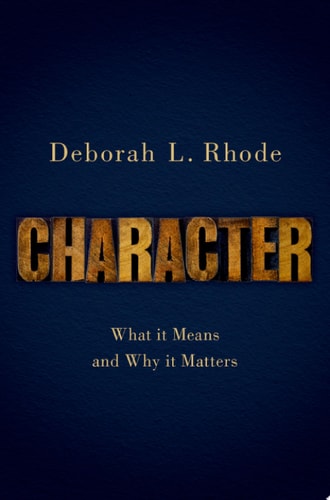
Character: What It Means and Why It Matters
0
0
As an Amazon Associate and affiliate partner, Menrva Books earns from qualifying purchases. Learn more
Author Description
Americans claim to care about character. Over four fifths want it taught in public schools, and 95 percent think that a president's character is important. And historically, philosophers, educators, politicians, religious leaders, judges, and the general public have agreed that character should be valued and reinforced. Yet in the United States, the institutions charged with that mission have consistently fallen short. Simply put, too little effort has been made to understand the importance of character and the strategies that can best develop and support it. After first exploring the history of the concept over time, Deborah Rhode turns her focus to the institutions that have traditionally fostered good character: families, schools, youth organizations, civic groups, and political organizations. However, as we have increasingly de-emphasized the subject-a trend that is most evident in our politics-our awareness of its shaping influence has waned. Indeed, we often focus on the wrong things when it comes to fostering good character. For instance, almost a third of the workforce is covered by licensing laws requiring good moral character, even occupations where the need for screening is not self-evident: florist, fortune teller, and frog farmers. Character also plays a pivotal role in the criminal justice system, in defining guilt, punishment, and eligibility for parole. All too often, these legal requirements are idiosyncratic, inequitable, and subject to race and class bias. Millions of Americans who have convictions for minor offenses are excluded from a vast range of occupations and benefits without evidence that such exclusion serves the public interest. We can do better, she stresses, and outlines a powerful program for reform. Rhode punctuates the book through a series of portraits of exemplary individuals whose good character made them who they were: Ida B. Wells, Jane Addams, Martin Luther King, Mother Teresa, Nelson Mandela, Albert Schweitzer, and Thurgood Marshall.
Menrva's Summary
THE THESIS
This book investigates the historical, social, and legal significance of character in American life and questions why institutions have failed to effectively cultivate or define it. Deborah L. Rhode, a prominent legal scholar and professor, utilizes a multidisciplinary approach to examine how character is perceived in public discourse versus how it is applied in institutional settings. She argues that current systems, particularly within the legal and political spheres, rely on inconsistent and biased metrics that often fail to serve the public interest.
THE SCOPE MAP
What You Will Find
- Historical analysis of the evolution of the concept of character in Western thought.
- Evaluation of institutions such as schools, families, and civic organizations in character development.
- Critique of occupational licensing laws and criminal justice policies regarding moral character requirements.
- Biographical portraits of figures including Ida B. Wells, Jane Addams, and Nelson Mandela.
Scope Limits
- The text does not provide a comprehensive psychological study of individual personality development.
- It does not offer a universal, standardized definition of character that satisfies all philosophical traditions.
THE AUTHORITY PERSPECTIVE
Experts recognize this work as a rigorous critique of the intersection between moral philosophy and contemporary American legal practice. Readers frequently note the author's ability to balance historical context with actionable policy recommendations for institutional reform.
Page Count:
332
Publication Date:
2019-01-01
Publisher:
Oxford University Press
ISBN-10:
0190919892
ISBN-13:
9780190919894
Philosophy
Ethics
Social Reform
Professional Career & Trade
Character
Sociology
Public Policy
Community Tags
Similar Books