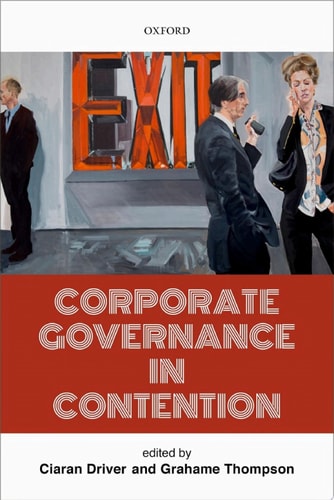
Corporate Governance in Contention
0
0
As an Amazon Associate and affiliate partner, Menrva Books earns from qualifying purchases. Learn more
Author Description
Corporate governance is a complex idea that is often inappropriately simplified as a cookbook of recommended measures to improve financial performance. Meta studies of published research show that the supposed benign effects of these measures - independent directors or highly incentivised executives - are at best context-specific. There is thus a challenge to explain the meaning, purpose, and importance of corporate governance. This volume addresses these issues. The issues discussed centre on relationships within the firm e.g. between labour, managers, and investors, and relationships outside the firm that affect consumers or the environment. The essays in this collection are the considered selection by the editors and the contributors themselves of what are seen as some of the most weighty and urgent issues that connect the corporation and society at large in developed economies with established property rights. The essays are to be read in dialogue with each other, giving a richer understanding than could be obtained by shepherding all contributions into a single mould. Nevertheless taken together they demonstrate a shared sense of deep concern that the corporate governance agenda has been and still is on the wrong track. The contributors, individually and collectively, identify in this compendium both a research programme and a platform for change.
Menrva's Summary
THE THESIS
This volume investigates the fundamental disconnect between standardized corporate governance measures and their actual impact on firm performance and societal outcomes. Editors Ciaran Driver and Grahame F. Thompson compile a series of scholarly essays that challenge the prevailing view of governance as a simple checklist for financial success. By examining the complex power dynamics between labor, management, and investors, the authors argue that current governance agendas are misaligned with broader social responsibilities and economic realities.
THE SCOPE MAP
What You Will Find
- Analysis of internal firm relationships between labor, managers, and shareholders
- Critique of meta-studies regarding independent directors and executive compensation
- Examination of external corporate impacts on consumers and the environment
- A proposed research agenda for future governance reform
Scope Limits
- Focuses primarily on developed economies with established property rights
- Does not provide a prescriptive 'how-to' manual for corporate compliance
THE AUTHORITY PERSPECTIVE
Experts recognize this collection as a critical intervention in the field of corporate governance, noting its departure from mainstream management literature. Readers frequently highlight the academic density of the prose and the authors' success in framing governance as a socio-political issue rather than a purely financial one.
Page Count:
336
Publication Date:
2018-01-01
Publisher:
OUP Oxford
ISBN-10:
0192527665
ISBN-13:
9780192527660
Economics
Management
Business Ethics
Sociology
Corporate governance
Community Tags
Similar Books