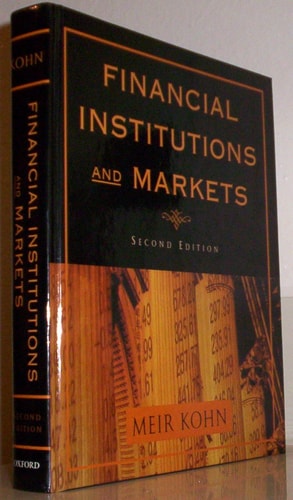
Financial Institutions and Markets
0
0
As an Amazon Associate and affiliate partner, Menrva Books earns from qualifying purchases. Learn more
Author Description
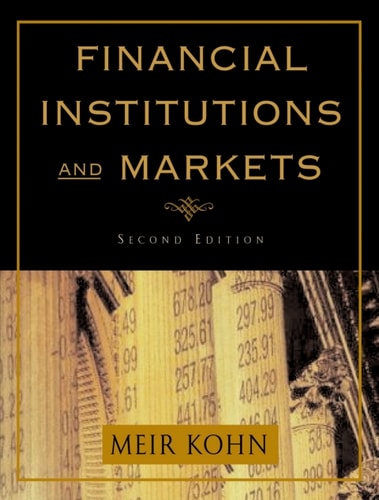
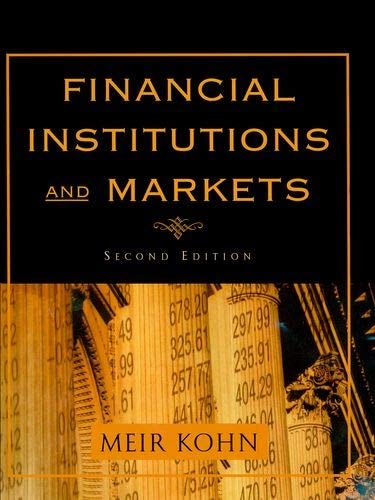
Why do financial institutions and markets have the structure they do? Why is that structure changing? These questions are central to the scope and purpose of Meir G. Kohn's Financial Institutions and Markets, 2/e. Unlike most books designed for financial markets and institutions courses, this successful text focuses on the "why" of existing and evolving markets and instruments as well as the "how."Financial Institutions and Markets, 2/e, makes clear the general principles and economic functions underlying all financial intermediaries. It provides a thorough discussion of the specifics of banking, insurance, pension funds, and mutual funds. In a similar fashion, the book elucidates the general principles and economic functions common to all financial markets and offers an in-depth look at the specifics of the particular markets for government securities, mortgages, corporate debt, equity, and derivatives. The final section addresses the management of liquidity and risk and discusses the safety, stability, and regulation of financial intermediaries and financial markets.Each chapter begins with a list of study objectives and concludes with a summary. Key terms are listed at the end of each chapter and defined in marginal glossaries as they occur in the text. End-of-chapter questions are included to provide a stimulus for discussion. Accessible to a wide range of students, Financial Institutions and Markets, 2/e, is ideal for courses in financial institutions, financial markets, or a combination of institutions and markets at either the undergraduate or graduate level.
Menrva's Summary
THE THESIS
What economic principles and functional requirements dictate the structural evolution of modern financial institutions and markets? Meir Kohn, an established economist, utilizes this text to move beyond descriptive mechanics by analyzing the underlying logic that drives the development of financial intermediaries and instruments. The book provides a comprehensive framework for understanding why specific institutions exist and how they adapt to changing economic environments.
THE SCOPE MAP
What You Will Find
- Analysis of the economic functions of banking, insurance, pension funds, and mutual funds.
- Examination of specific market sectors including government securities, mortgages, corporate debt, equity, and derivatives.
- Methodological focus on the management of liquidity and systemic risk.
- Discussion of regulatory frameworks and the maintenance of stability within financial systems.
THE AUTHORITY PERSPECTIVE
Experts and educators frequently cite this text for its ability to bridge the gap between theoretical economic principles and practical market operations. Readers often note the clarity of the prose, which makes complex institutional structures accessible to both undergraduate and graduate students.
Page Count:
704
Publication Date:
2003-07-03
Publisher:
Oxford University Press
ISBN-10:
0195134729
ISBN-13:
9780195134728
Business
Economics
textbook
Money market
Capital market
Banking
Finance
Community Tags
Other Editions(4)
Similar Books







Reader Comments
Share Your Thoughts
No comments yet. Be the first to share your thoughts!