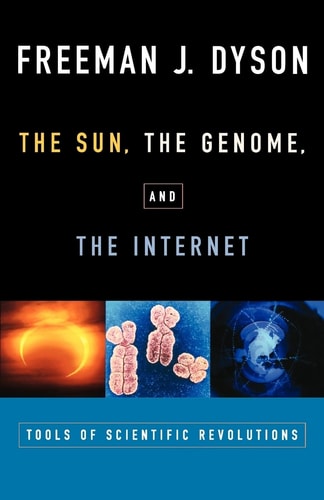
The Sun, The Genome, and The Internet: Tools of Scientific Revolution
0
0
As an Amazon Associate and affiliate partner, Menrva Books earns from qualifying purchases. Learn more
Author Description
In this visionary look into the future, Freeman Dyson argues that technological changes fundamentally alter our ethical and social arrangements and that three rapidly advancing new technologies--solar energy, genetic engineering, and world-wide communication--together have the potential to create a more equal distribution of the world's wealth.Dyson begins by rejecting the idea that scientific revolutions are primarily concept driven. He shows rather that new tools are more often the sparks that ignite scientific discovery. Such tool-driven revolutions have profound social consequences--the invention of the telescope turning the Medieval world view upside down, the widespread use of household appliances in the 1950s replacing servants, to cite just two examples. In looking ahead, Dyson suggests that solar energy, genetics, and the Internet will have similarly transformative effects, with the potential to produce a more just and equitable society. Solar power could bring electricity to even the poorest, most remote areas of third world nations, allowing everyone access to the vast stores of information on the Internet and effectively ending the cultural isolation of the poorest countries. Similarly, breakthroughs in genetics may well enable us to give our children healthier lives and grow more efficient crops, thus restoring the economic and human vitality of village cultures devalued and dislocated by the global market.Written with passionate conviction about the ethical uses of science, The Sun, the Genome, and the Internet is both a brilliant reinterpretation of the scientific process and a challenge to use new technologies to close, rather than widen, the gap between rich and poor.
Menrva's Summary
THE THESIS
Freeman J. Dyson investigates whether the rapid advancement of solar energy, genetic engineering, and global communication can serve as catalysts for a more equitable distribution of global wealth. Dyson, a renowned theoretical physicist, utilizes historical analysis of past technological shifts to argue that scientific revolutions are primarily driven by the introduction of new tools rather than conceptual breakthroughs. He posits that these three specific technologies possess the capacity to bridge the widening gap between affluent and impoverished nations by decentralizing power and resources.
THE SCOPE MAP
What You Will Find
- Historical analysis of tool-driven scientific revolutions, including the impact of the telescope and household appliances.
- A framework for evaluating the ethical implications of emerging technologies.
- Case studies on the potential for solar energy to provide electricity to remote, underdeveloped regions.
- An examination of how genetic engineering and internet access can restore economic vitality to marginalized village cultures.
THE AUTHORITY PERSPECTIVE
Experts and readers frequently note the accessibility of Dyson's prose, which distills complex scientific and social concepts into a clear, visionary argument. The text is widely regarded as a foundational work for those interested in the intersection of technological progress and social justice.
Page Count:
144
Publication Date:
2000-10-19
Publisher:
New York Public Library
ISBN-10:
0195139224
ISBN-13:
9780195139228
Science
Non-Fiction
Technology
Ethics
Sociology
Discoveries in science
Future Studies
Community Tags
Similar Books