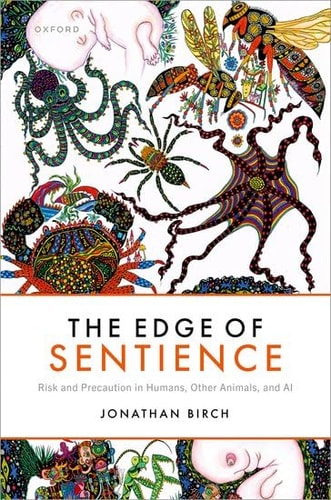
The Edge of Sentience: Risk and Precaution in Humans, Other Animals, and AI
0
0
As an Amazon Associate and affiliate partner, Menrva Books earns from qualifying purchases. Learn more
Author Description
Cover -- The Edge Of Sentience: Risk And Precaution In Humans, Other Animals, And Ai -- Copyright -- Dedication -- Epigraph -- Contents -- List Of Illustrations -- Summary Of The Framework And Proposals -- Precautionary Framework -- Proposals About Specific Cases -- People With Disorders Of Consciousness -- Human Fetuses And Embryos -- Human Neural Organoids -- Other Animals -- Artificial Intelligence (ai) -- 1: A Walk Along The Edge -- 1.1 The Unmarked Border -- 1.2 Decision Points -- 1.3 When To Stop? -- 1.4 Accidental Golems -- 1.5 The Goal: A Precautionary Framework 1.6 A Note On Influences -- 1.7 Summary Of Chapter 1 -- 2: The Concept Of Sentience -- 2.1 Sentience And Consciousness -- 2.2 'phenomenal Consciousness' As Unstable Common Ground -- 2.3 Affective Space -- 2.4 Affective Spaces Beyond The Human Case -- 2.5 Three Views On The Nature Of Valence -- 2.6 The Ethical Significance Of Valence -- 2.7 Summary Of Chapter 2 -- Part I: The Zone Of Reasonable Disagreement -- 3: The Mind-body Problem -- 3.1 Disagreeing Reasonably About Sentience -- Baseless Recommendations -- Dogmatism -- Moral Views Beyond The Pale 3.2 Might Conscious Experience Leave No Trace On Behaviour? -- 3.3 Is Conscious Experience One Kind Or Many? -- 3.4 Radical Alternatives -- Interactionist Dualism -- Russellian Monism -- Biopsychism -- The Integrated Information Theory -- 3.5 Are Agency And Embodiment Necessary? -- 3.6 The Relevant Scale Of Functional Organization -- 3.7 Are There Borderline (indeterminate) Cases Of Sentience? -- 3.8 Summary Of Chapter 3 -- 4: Ethics And Religion -- 4.1 Bio- And Ecocentrism -- 4.2 Agency-centric Views -- 4.3 Consciousness Without Valence -- 4.4 Rationality-centric Views 4.5 Abrahamic Religions And The Stewardship Tradition -- 4.6 Indian Religions And Ahimsa -- 4.7 Summary Of Chapter 4 -- 5: The Science Of Consciousness And Emotion -- 5.1 Grades Of Optimism -- 5.2 The Conscious And The Unconscious: The Case Of Blindsight -- 5.3 The Conscious And The Uncons
Menrva's Summary
THE THESIS
This book investigates how we should make moral decisions when we are uncertain about whether a being—whether human, animal, or artificial—possesses the capacity for sentience. Jonathan Birch, a philosopher of science at the London School of Economics, utilizes a framework of precautionary ethics to navigate the 'zone of reasonable disagreement' regarding consciousness. He argues that when the stakes involve potential suffering, we must adopt a precautionary approach that prioritizes the moral status of entities even in the absence of definitive scientific proof of their subjective experience.
THE SCOPE MAP
What You Will Find
- A formal precautionary framework for moral decision-making under uncertainty.
- Analysis of affective space and the role of valence in determining moral status.
- Evaluations of specific cases including human fetuses, neural organoids, and artificial intelligence.
- A review of competing theories of consciousness, including Integrated Information Theory and biopsychism.
Scope Limits
- The text does not provide a definitive scientific solution to the mind-body problem.
- It does not offer a comprehensive legal policy manual but rather a philosophical foundation for future regulation.
THE AUTHORITY PERSPECTIVE
Experts in philosophy and AI ethics recognize this work as a significant contribution to the growing field of machine and animal sentience. Readers frequently note the academic density of the prose, which requires a foundational understanding of philosophy of mind to fully grasp the author's arguments.
Page Count:
0
Publication Date:
1900-01-01
Publisher:
Oxford University Press,
ISBN-10:
019196672X
ISBN-13:
9780191966729
Philosophy
Science
Perception Philosophie
Ethics
Animal Rights
Consciousness
Perception philosophy
Cognition
Consciousness Studies
Conscience
Community Tags
Similar Books