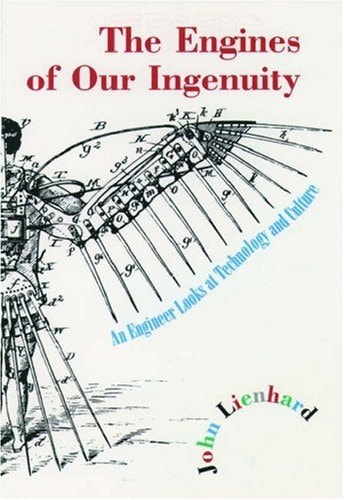
The Engines of Our Ingenuity: An Engineer Looks at Technology and Culture
0
0
As an Amazon Associate and affiliate partner, Menrva Books earns from qualifying purchases. Learn more
Author Description
A million people tune in twice each week to hear John H. Lienhard's radio program "The Engines of Our Ingenuity." Now Lienhard has gathered together his reflections on the nature of technology, culture, human inventiveness, and the history of engineering in this fascinating new book.The Engines of Our Ingenuity offers a series of intriguing glimpses into technology--as a mirror, as a danger, as a product of heroic hubris. The book brims with insightful observations. Lienhard writes, for instance, that the history of technology is a history of us--we are the machines we create. Indeed, our very first technology, farming, which demanded year-long care, dramatically changed the rhythms of human life and the course of our history. We also learn that war does not necessarily fuel invention (radar, jets, and the digital computer all emerged before World War II began), and that the medieval Church was actually a driving force behind the growth of Western technology (Cistercian monasteries were virtual factories, putting water wheels to work in wood-cutting, forging, and olive crushing). Lienhard also illuminates the unpredictable nature of the inventive mind, leading us through one fascinating example after another. Thomas Edison and Nikola Tesla, for instance, were highly passionate, even combative figures, while the almost invisible Josiah Willard Gibbs, living a quiet, outwardly uneventful life, was probably America's greatest scientist.Lienhard ranges far and wide with stories of inventors, mathematicians, and engineers, telling the story of the canoe, the DC-3, the Hoover Dam, the diode, and the sewing machine. The result is less history than autobiography--for the autobiography of all of us is written in our machines.
Menrva's Summary
THE THESIS
This work investigates the symbiotic relationship between human culture and technological advancement, positing that our machines serve as an autobiography of the human experience. John H. Lienhard IV, a professor emeritus of mechanical engineering and history, draws upon his extensive background in engineering and his experience hosting a long-running radio program to synthesize these reflections. He argues that technology is not merely a collection of tools but a fundamental expression of human inventiveness, hubris, and societal evolution. By examining historical milestones and the lives of inventors, the author constructs a framework that links technical progress directly to the rhythms of human life.
THE SCOPE MAP
What You Will Find
- Historical analysis of technological milestones including the development of farming, the DC-3, and the Hoover Dam.
- Biographical sketches of key figures such as Thomas Edison, Nikola Tesla, and Josiah Willard Gibbs.
- Examination of the relationship between institutional forces, such as the medieval Church, and technological growth.
- Discussion of the unpredictable nature of invention and the debunking of common myths regarding war-driven innovation.
THE AUTHORITY PERSPECTIVE
Experts and readers alike identify this text as an accessible, humanistic approach to the history of engineering that bridges the gap between technical and cultural studies. The prose is noted for its conversational tone, which successfully translates complex historical and mechanical concepts for a general audience.
Page Count:
272
Publication Date:
2000-06-29
Publisher:
Oxford University Press
ISBN-10:
0195135830
ISBN-13:
9780195135831
Science
History
Technology
Engineering
Culture
Community Tags
Similar Books