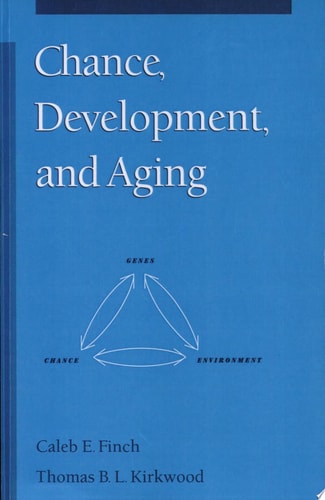
Chance, Development, and Aging
0
0
As an Amazon Associate and affiliate partner, Menrva Books earns from qualifying purchases. Learn more
Author Description
In Chance, Development, and Aging, two leading biological gerontologists review and evaluate all of the available data to elucidate the respective roles played by genes and chance developmental events in determining the course of aging in individuals. The combination of genetic and external environmental influences provides only an incomplete answer. Inbred laboratory animals, for example, exhibit a wide range of life spans despite having nearly identical genes and environments. Similarly, uncovering the genetic risks for Alzheimer's disease has not enabled doctors to predict with confidence its onset and severity. This book argues that understanding chance events, specifically random variations during prenatal development, is essential for answering these questions. The book draws on the extensive research in developmental biology on random variations in form and function, while putting this research in a new context. The discussion sheds light on a range of questions, from understanding menopause to explaining why identical twins are not truly identical. The book will be invaluable for gerontologists, geneticists, developmental and reproductive biologists, physiologists, and a broad range of physicians and investigators in experimental medicine.
Menrva's Summary
THE THESIS
This book investigates the extent to which random developmental events, rather than solely genetic or environmental factors, dictate the trajectory of individual aging. Authors Caleb E. Finch and Tom Kirkwood, both distinguished biological gerontologists, synthesize existing data to challenge the traditional reliance on genetic and environmental models. They propose a framework that incorporates stochastic variations occurring during prenatal development to explain the significant biological diversity observed in aging populations, including identical twins and inbred laboratory models.
THE SCOPE MAP
What You Will Find
- Analysis of stochastic processes in prenatal development and their long-term physiological consequences.
- Evaluation of genetic and environmental limitations in predicting disease onset, such as Alzheimer's.
- Synthesis of comparative data from laboratory animal studies and human clinical observations.
- Examination of biological phenomena including menopause and phenotypic variation in identical twins.
THE AUTHORITY PERSPECTIVE
Experts in the fields of gerontology and developmental biology recognize this work as a significant contribution to the understanding of biological variability. The text is noted for its rigorous synthesis of complex data, making it a primary resource for researchers and clinicians investigating the mechanisms of aging.
Page Count:
278
Publication Date:
2000-01-15
Publisher:
Oxford University Press
ISBN-10:
0195133617
ISBN-13:
9780195133615
Science
Developmental Psychology
Gerontology
Developmental Biology
Biology
Chance
Genetics
Community Tags
Similar Books