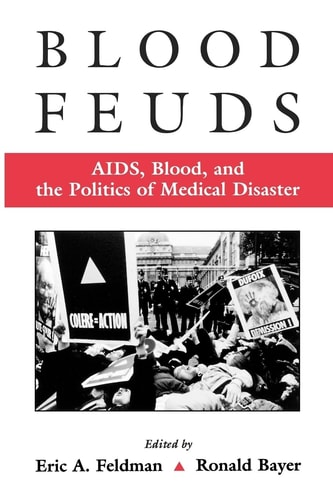
Blood Feuds: AIDS, Blood, and the Politics of Medical Disaster
0
0
As an Amazon Associate and affiliate partner, Menrva Books earns from qualifying purchases. Learn more
Author Description
In the mid-1980s public health officials in North America, Europe, Japan, and Australia discovered that almost half of the hemophiliac population, as well as tens of thousands of blood transfusion recipients, had been infected with HIV-tainted blood. This book provides a comparative perspective on the political, legal, and social struggles that emerged in response to the HIV contamination of the blood supply of the industrialized world. It describes how eight nations responded to the first signs that AIDS might be transmitted through blood, how early efforts to secure the blood supply faltered, and what measures were ultimately implemented to resolve the contamination. The authors detail the remarkable mobilization of hemophiliacs who challenged the state, the medical establishment, and their own caregivers to seek recompense and justice. In the end, the blood establishments in almost all the advanced industrial nations were shaken. In Canada, the Red Cross was forced to withdraw from blood collection and distribution. In Japan, pharmaceutical firms that manufactured clotting factor agreed to massive compensation -- $500,000 per hemophiliac infected. In France, blood officials went to prison. Even in Denmark, where the number of infected hemophiliacs was relatively small, the struggle and litigation surrounding blood has resulted in the most protracted legal and administrative conflict in modern Danish history. Blood Feuds brings together chapters on the experiences of the United States, Japan, France, Canada, Germany, Denmark, Italy, and Australia with four comparative essays that shed light on the cultural, institutional, and economic dimensions of the HIV/blood disaster.
Menrva's Summary
THE THESIS
This book investigates how industrialized nations managed the catastrophic failure of their blood supply systems during the HIV/AIDS crisis of the 1980s. Authors Eric A. Feldman and Ronald Bayer utilize a comparative framework to analyze the political, legal, and social responses across eight different countries. By examining the intersection of medical ethics, government oversight, and patient advocacy, the authors argue that the crisis fundamentally altered the relationship between state institutions, the medical establishment, and the public.
THE SCOPE MAP
What You Will Find
- Comparative analysis of HIV contamination responses in the United States, Japan, France, Canada, Germany, Denmark, Italy, and Australia.
- Detailed accounts of legal battles and compensation schemes for infected hemophiliacs.
- Examination of the institutional collapse and restructuring of national blood collection agencies.
- Analysis of the cultural and economic factors that influenced public health policy decisions.
THE AUTHORITY PERSPECTIVE
Experts recognize this work as a definitive comparative study on the intersection of public health policy and legal accountability. Readers frequently note the meticulous documentation of international case studies, which provides a clear understanding of how different political systems handled the same medical disaster.
Page Count:
375
Publication Date:
1999-03-15
Publisher:
Oxford University Press
ISBN-10:
0195131606
ISBN-13:
9780195131604
Politics
History
Sociology
Law
Blood Banks
Social Aspects
Public Health
Medicine
Collection and preservation
Community Tags
Other Editions(2)
Similar Books