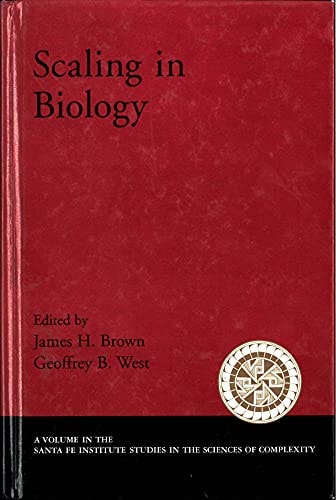
Scaling in Biology (Santa Fe Institute Studies on the Sciences of Complexity)
0
0
As an Amazon Associate and affiliate partner, Menrva Books earns from qualifying purchases. Learn more
Author Description
Scaling relationships have been a persistent theme in biology at least since the time of Leonardo da Vinci and Galileo. Because scaling relationships are among the most general empirical patterns in biology, they have stimulated research to develop mechanistic hypotheses and mathematical models. While there have been many excellent empirical and theoretical investigations, there has been little attempt to synthesize this diverse but interrelated area of biology.In an effort to fill this void, Scaling in Biology, the first general treatment of scaling in biology in over 15 years, covers a broad spectrum of the most relevant topics in a series of chapters written by experts in the field. Some of those topics discussed include allometry and fractal structure, branching of vascular systems of mammals and plants, biomechanical and life history of plants, invertebrates and vertebrates, and species-area patterns of biological diversity. Many more examples are included within this text to complete the broader picture.Scaling in Biology conveys the diversity, promise, and excitement of current research in this area, in a format accessible to a wide audience of not only specialists in the various sub-disciplines, but also students and anyone with a serious interest in biology.
Menrva's Summary
THE THESIS
This volume investigates the fundamental question of how scaling relationships serve as universal empirical patterns that govern biological structure and function across diverse species. The editors, Geoffrey B. West and James H. Brown, curate a collection of expert contributions that synthesize decades of research into a unified mathematical and mechanistic framework. By examining the physical and logical constraints of biological systems, the text provides a comprehensive overview of how scaling laws influence everything from metabolic rates to species distribution.
THE SCOPE MAP
What You Will Find
- Analysis of allometry and fractal structures in living organisms
- Mathematical modeling of branching vascular systems in mammals and plants
- Comparative biomechanical and life history studies of invertebrates and vertebrates
- Examination of species-area patterns and the maintenance of biological diversity
THE AUTHORITY PERSPECTIVE
Experts recognize this work as a foundational synthesis that bridges the gap between empirical observation and theoretical biology. Readers frequently note the technical density of the prose, which serves as a primary reference for researchers and advanced students in the field of complexity science.
Page Count:
368
Publication Date:
2000-04-06
Publisher:
Oxford University Press
ISBN-10:
019513141X
ISBN-13:
9780195131413
Science
Evolutionary Biology
Biophysics
Biomathematics
Mathematics
Body Size
Biology
Ecology
Community Tags
Similar Books