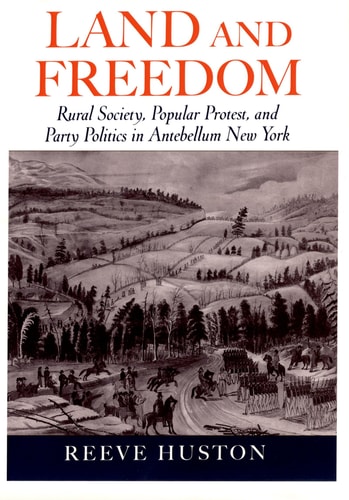
Land and Freedom: Rural Society, Popular Protest, and Party Politics in Antebellum New York
0
0
As an Amazon Associate and affiliate partner, Menrva Books earns from qualifying purchases. Learn more
Author Description
During the early nineteenth-century, two million acres of New York's farmland were controlled by a handful of great families. Along the Hudson Valley and across the Catskills lay the great estates of the Van Rensselaers, the Livingstons, and a dozen lesser landlords. Some two hundred and sixty thousand men, women, and children-a twelfth of the population of New York, the nation's most populous state-worked this land as tenants. Beginning in 1839, these tenants created a movement dedicated to destroying the estates and distributing the land to those who farmed it. The "anti-rent" movement quickly became one of the most powerful and influential movements of the antebellum era.The anti-renters raised issues that lay at the heart of America's republican experiment: the distribution of land, the nature of democracy, and the meaning of freedom. In doing so, they left an indelible mark on politics and public ideals in both New York and the nation. They influenced and bitterly divided both major political parties, and helped create the Republican party. Moreover, they shaped the ideas, policies, and careers of such national leaders as Martin Van Buren, Silas Wright, Horace Greeley, and William Seward.Deftly interweaving an engaging narrative history with broad-ranging social and political analysis, Land and Freedom brings to life the voices of antebellum northern farmers as they debated the critical social and political issues of their day. It grounds those debates in a detailed analysis of social and political change on New York's estates, and demonstrates the impact of farmers' ideas and initiatives on the broader social and political order. In doing so, it offers new insights into the social and political thought of northeastern farmers, the extent and limits of popular political power under the Jacksonian political order, and the social origins of free-labor ideology and the Republican party.
Menrva's Summary
THE THESIS
This work investigates how the anti-rent movement in nineteenth-century New York challenged the concentration of land ownership and reshaped the trajectory of American democratic politics. Reeve Huston, a historian specializing in nineteenth-century American social and political movements, utilizes extensive primary source documentation to analyze the intersection of agrarian protest and party politics. He argues that the struggle of tenant farmers against the great estates of the Hudson Valley was not merely a local dispute, but a fundamental conflict that influenced the development of free-labor ideology and the formation of the Republican party.
THE SCOPE MAP
What You Will Find
- A detailed examination of the anti-rent movement spanning from 1839 through the mid-nineteenth century.
- Analysis of the socio-economic structure of New York's great estates and the tenant-landlord relationship.
- Evaluation of how agrarian protest influenced the political careers of figures like Martin Van Buren and William Seward.
- Exploration of the ideological transition from Jacksonian democracy to the rise of the Republican party.
THE AUTHORITY PERSPECTIVE
Historians and scholars of the antebellum period recognize this text as a definitive account of the anti-rent movement's impact on national political development. Readers frequently note the academic rigor and the depth of the archival research presented throughout the narrative.
Page Count:
304
Publication Date:
2000-10-12
Publisher:
Oxford University Press
ISBN-10:
0195136004
ISBN-13:
9780195136005
History
Social History
Land tenure
American History
Nineteenth century
New York
Community Tags
Similar Books














