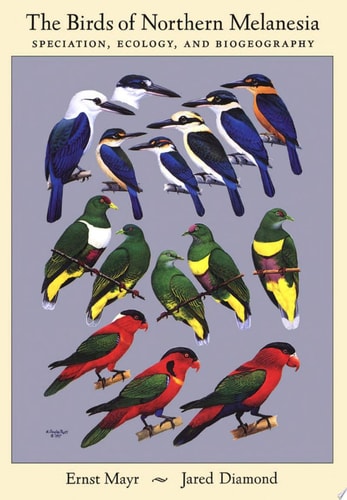
The Birds of Northern Melanesia: Speciation, Dispersal and Biogeography
0
0
As an Amazon Associate and affiliate partner, Menrva Books earns from qualifying purchases. Learn more
Author Description
Speciation is the process by which co-existing daughter species evolve from one ancestral species - e.g., humans, chimpanzees, and gorillas arising from a common ancestor around 5,000,000 years ago. However, many questions about speciation remain controversial. The Birds of Northern Melanesia provides by far the most comprehensive study yet available of a rich fauna, composed of the 195 breeding land and fresh-water bird species of the Bismarck and Solomon Archipelagoes east of New Guinea. This avifauna offers decisive advantages for understanding speciation, and includes famous examples of geographic variation discussed in textbooks of evolutionary biology.The book results from 30 years of collaboration between the evolutionary biologist Ernst Mayr and the ecologist Jared Diamond. It shows how Northern Melanesian bird distributions provide snapshots of all stages in speciation, from the earliest (widely distributed species without geographic variation) to the last (closely related, reproductively isolated species occurring sympatrically and segregating ecologically). The presentation emphasizes the wide diversity of speciation outcomes, steering a middle course between one-model-fits-all simplification and ungeneralizable species accounts. Questions illuminated include why some species are much more prone to speciate than others, why some water barriers are much more effective at promoting speciation than others, and whether hypothesized taxon cycles, faunal dominance, and legacies of Pleistocene land bridges are real.These years of study have resulted in a huge database, complete with distributions of all 195 species on 76 islands, together with their taxonomy, colonization routes, ecological attributes, abundance, and overwater dispersal. Color plates depict 88 species and allospecies, many of which have never been seen before. For students of speciation, Northern Melanesian birds now constitute a model system against which other biotas can be compared.
Menrva's Summary
THE THESIS
This work investigates the mechanisms of speciation and biogeographic distribution by analyzing the avifauna of the Bismarck and Solomon Archipelagoes. Ernst Mayr, a foundational figure in evolutionary biology, and Jared Diamond, a prominent ecologist, synthesize three decades of collaborative research to examine how 195 bird species evolved and dispersed across these island chains. The authors utilize this specific regional data to challenge oversimplified models of evolution, arguing instead for a nuanced understanding of how geographic barriers and ecological factors drive the formation of new species.
THE SCOPE MAP
What You Will Find
- A comprehensive database detailing the distribution of 195 breeding land and fresh-water bird species across 76 islands.
- Analysis of evolutionary stages ranging from initial geographic variation to full reproductive isolation.
- Examination of complex biological phenomena including taxon cycles, faunal dominance, and the impact of Pleistocene land bridges.
- Taxonomic classifications, colonization route mapping, and ecological attribute assessments for the studied species.
THE AUTHORITY PERSPECTIVE
Experts recognize this volume as a foundational reference for the study of island biogeography and evolutionary processes. Readers frequently note the high level of academic density and the meticulous nature of the data, which serves as a critical model system for comparative biological research.
Page Count:
548
Publication Date:
2001-12-06
Publisher:
Oxford University Press
ISBN-10:
0195141709
ISBN-13:
9780195141702
Nature
Science
Ornithology
Evolutionary Biology
Biogeography
Biology
Community Tags
Similar Books








Reader Comments
Share Your Thoughts
No comments yet. Be the first to share your thoughts!