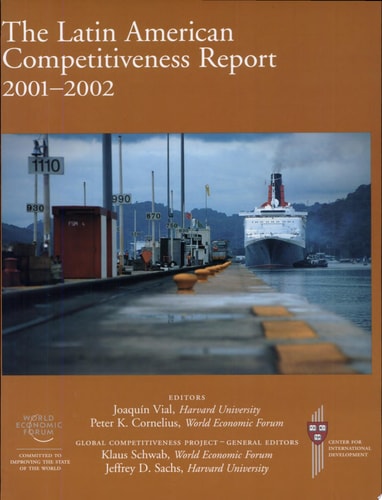
The Latin American Competitiveness Report 2001-2002
0
0
As an Amazon Associate and affiliate partner, Menrva Books earns from qualifying purchases. Learn more
Author Description
Product Description Throughout the last decade, Latin America has made tremendous progress in undertaking significant structural reforms. In many countires, state-owned enterprises have been privatized, basic infrastructure has been built, and capital markets have been established. In more advanced countries inthe region, foreign investment flows have soared and trade performance has dramatically improved. These reforms are even more remarkeable when placed in the context of the numerous upheavals, both economic and financial, that have affected the region in recent years. However, Latin America is also a region that has failed to deliver the kind of economic performance that most observers expected, given its wealth of natural resources, proximity to North America and Europe, and relative level of development. Despite the region's indisputable economic and socialaccomplishments, gains have varied widely among these countries. While some have successfully implemented macroeconomic, political, and institutional reforms, many countries have yet to create the necessary conditions for fostering economic growth and competitiveness. The Latin American Competitiveness Report 2001-2002 highlights the prospects for growth in the region, and, more importantly, reveals the obstacles to competitiveness. Through in-depth analysis of regional trends and detailed country profiles, the Report assesses the comparative strengths andweaknesses of the leading economies in Latin America. It also contains essays on a variety of issues relevant to competitiveness along with an assessment of the impact of the events of September 11th on the longer-term prospects of the region. The Latin American Competitiveness Report 2001-2002 isan invaluable tool for policymakers, business strategists, and other important stakeholders as well as essential reading for all with an interest in the region.
Menrva's Summary
THE THESIS
This report investigates the primary obstacles to economic growth and competitiveness within Latin American nations at the turn of the 21st century. The World Economic Forum utilizes a combination of macroeconomic data, institutional analysis, and regional trend assessments to evaluate why certain countries succeeded in reform while others stagnated. The text provides a framework for understanding how structural adjustments, privatization, and trade performance interact with the region's unique geopolitical and financial challenges.
THE SCOPE MAP
What You Will Find
- Comparative analysis of economic strengths and weaknesses across leading Latin American economies.
- Detailed country-specific profiles assessing institutional and political reform progress.
- Expert essays addressing regional competitiveness and the long-term economic impact of the September 11th events.
- Quantitative and qualitative assessment of infrastructure development and capital market integration.
THE AUTHORITY PERSPECTIVE
Experts and policymakers frequently utilize this report as a foundational reference for understanding the regional economic landscape of the early 2000s. Readers often note the academic density of the prose and the comprehensive nature of the data provided.
Page Count:
224
Publication Date:
2002-01-15
Publisher:
Oxford University Press
ISBN-10:
0195152565
ISBN-13:
9780195152562
Economics
Business
International relations
Latin America
Public Policy
Community Tags
Similar Books