Secrets, Gossip, and Gods: The Transformation of Brazilian Candomblé
0
0
As an Amazon Associate and affiliate partner, Menrva Books earns from qualifying purchases. Learn more
Author Description
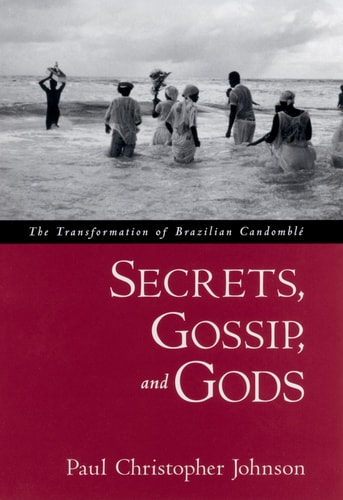
In this wide-ranging book Paul Christopher Johnson explores the changing, hidden face of the Afro-Brazilian indigenous religion of Candomblé. Despite its importance in Brazilian society, Candomblé has received far less attention than its sister religions Vodou and Santeria. Johnson seeks to fill this void by offering a comprehensive look at the development, beliefs, and practices of Candomblé and exploring its transformation from a secret society of slaves--hidden, persecuted, and marginalized--to a public religion that is very much a part of Brazilian culture. Johnson traces this historical shift and locates the turning point in the creation of Brazilian national identity and a public sphere in the first half of the twentieth century.His major focus is on the ritual practice of secrecy in Candomblé. Like Vodou and Santeria and the African Yoruba religion from which they are descended, Candomblé features a hierarchic series of initiations, with increasing access to secret knowledge at each level. As Johnson shows, the nature and uses of secrecy evolved with the religion. First, secrecy was essential to a society that had to remain hidden from authorities. Later, when Candomblé became known and actively persecuted, its secrecy became a form of resistance as well as an exotic hidden power desired by elites. Finally, as Candomblé became a public religion and a vital part of Brazilian culture, the debate increasingly turned away from the secrets themselves and toward their possessors. It is speech about secrets, and not the content of those secrets, that is now most important in building status, legitimacy and power in Candomblé.Offering many first hand accounts of the rites and rituals of contemporary Candomblé, this book provides insight into this influential but little-studied group, while at the same time making a valuable contribution to our understanding of the relationship between religion and society.
Menrva's Summary
THE THESIS
This book investigates how the Afro-Brazilian religion of Candomblé transitioned from a marginalized, clandestine practice into a recognized and influential component of Brazilian national identity. Paul Christopher Johnson, an expert in religious studies, utilizes historical analysis and ethnographic fieldwork to examine the evolution of ritual secrecy. He argues that the function of secrecy within the religion shifted from a survival mechanism against persecution to a strategic tool for establishing status and legitimacy within the public sphere.
THE SCOPE MAP
What You Will Find
- Historical analysis of Candomblé development from the era of slavery to the twentieth century.
- Examination of the ritual hierarchy and the acquisition of secret knowledge.
- First-hand accounts and ethnographic observations of contemporary rites and rituals.
- Theoretical framework regarding the relationship between religious secrecy, power, and national identity.
THE AUTHORITY PERSPECTIVE
Scholars recognize this work as a significant contribution to the study of Afro-Brazilian religions, filling a notable gap in comparative literature alongside studies of Vodou and Santeria. Readers frequently note the clarity with which Johnson connects complex ritual practices to broader sociological shifts in Brazilian society.
Page Count:
240
Publication Date:
2002-08-15
Publisher:
Oxford University Press
ISBN-10:
0195150589
ISBN-13:
9780195150582
Religion
History
Sociology
Anthropology
Brazil
Community Tags
Similar Books