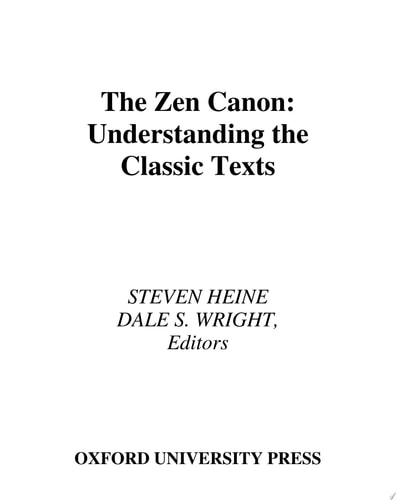
The Zen Canon: Understanding the Classic Texts
0
0
As an Amazon Associate and affiliate partner, Menrva Books earns from qualifying purchases. Learn more
Author Description
Bodhidharma, its first patriarch, reputedly said that Zen Buddhism represents "a special transmission outside the teaching/Without reliance on words and letters." This saying, along with the often perplexing use of language (and silence) by Zen masters, gave rise to the notion that Zen is a "lived religion," based strictly on non-linguistic practice and lacking a substantial canon of sacred texts. Even those who recognize the importance of Zen texts commonly limit their focus to a few select texts without recognizing the wide variety of Zen literature. This collection of previously unpublished essays argues that Zen actually has a rich and varied literary heritage. Among the most significant textual genres are hagiographic accounts and recorded sayings of individual Zen masters, koan collections and commentaries, and rules for monastic life. During times of political turmoil in China and Japan, these texts were crucial to the survival and success of Zen, and they have for centuries been valued by practitioners as vital expressions of the truth of Zen. This volume offers learned yet accessible studies of some of the most important classical Zen texts, including some that have received little scholarly attention (and many of which are accessible only to specialists). Each essay provides historical, literary, and philosophical commentary on a particular text or genre. Together, they offer a critique of the "de facto canon" that has been created by the limited approach of Western scholarship, and demonstrate that literature is a diverse and essential part of Zen Buddhism.
Menrva's Summary
THE THESIS
This volume investigates the misconception that Zen Buddhism lacks a substantial canon of sacred texts by examining the rich and varied literary heritage that has sustained the tradition for centuries. Author Dale Stuart Wright, alongside a collection of contributors, challenges the Western scholarly tendency to focus on a narrow selection of texts. By analyzing hagiographic accounts, recorded sayings, koan collections, and monastic rules, the book argues that literature is an essential, rather than peripheral, component of Zen practice and historical survival.
THE SCOPE MAP
What You Will Find
- Historical and philosophical analysis of classical Zen literary genres.
- Examination of hagiographic accounts and recorded sayings of Zen masters.
- Critical review of the 'de facto canon' established by Western scholarship.
- Contextual studies on how texts facilitated the survival of Zen during periods of political turmoil in China and Japan.
THE AUTHORITY PERSPECTIVE
Scholars and students of religious studies frequently highlight this work as a necessary correction to the anti-textual bias often found in popular perceptions of Zen. The text is noted for its academic rigor while remaining accessible to those interested in the intersection of Buddhist philosophy and literary history.
Page Count:
336
Publication Date:
2004-03-25
Publisher:
Oxford University Press
ISBN-10:
0195150686
ISBN-13:
9780195150681
Philosophy
Religion
Asian Studies
Zen Literature
Literary Criticism
Kindle Store
Kindle eBooks
Zen
Buddhism
Categories
Zen Buddhism
Community Tags
Similar Books