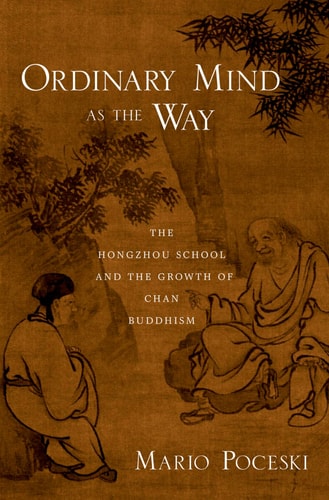
Ordinary Mind as the Way: The Hongzhou School and the Growth of Chan Buddhism
0
0
As an Amazon Associate and affiliate partner, Menrva Books earns from qualifying purchases. Learn more
Author Description
Under the leadership of Mazu Daoyi (709-788) and his numerous disciples, the Hongzhou School emerged as the dominant tradition of Chan (Zen) Buddhism in China during the middle part of the Tang dynasty(618-907). Mario Poceski offers a systematic examination of the Hongzhou School's momentous growth and rise to preeminence as the bearer of Chan orthodoxy, and analyzes its doctrines against the backdrop of the intellectual and religious milieus of Tang China. Poceski demonstrates that the Hongzhou School represented the first emergence of an empire-wide Chan tradition that had strongholds throughout China and replaced the various fragmented Schools of early Chan with an inclusive orthodoxy.Poceski's study is based on the earliest strata of permanent sources, rather than on the later apocryphal "encounter dialogue" stories regularly used to construe widely-accepted but historically unwarranted interpretations about the nature of Chan in the Tang dynasty. He challenges the traditional and popularly-accepted view of the Hongzhou School as a revolutionary movement that rejected mainstream mores and teachings, charting a new path for Chan's independent growth as a unique Buddhist tradition. This view, he argues, rests on a misreading of key elements of the Hongzhou School's history. Rather than acting as an unorthodox movement, the Hongzhou School's success was actually based largely on its ability to mediate tensions between traditionalist and iconoclastic tendencies. Going beyond conventional romanticized interpretations that highlight the radical character of the Hongzhou School, Poceski shows that there was much greater continuity between early and classical Chan-and between the Hongzhou School and the rest of Tang Buddhism-than previously thought.
Menrva's Summary
THE THESIS
This work investigates how the Hongzhou School of Chan Buddhism established itself as the dominant religious tradition during the middle Tang dynasty. Mario Poceski, a scholar of East Asian Buddhism, utilizes early primary source materials to construct a historical framework that challenges romanticized narratives of the school as a purely iconoclastic movement. By analyzing the school's doctrines within the broader intellectual and religious context of Tang China, the author argues that the Hongzhou School's success stemmed from its ability to synthesize traditionalist and radical tendencies rather than rejecting mainstream Buddhist practices.
THE SCOPE MAP
What You Will Find
- Historical analysis of the Hongzhou School's rise to prominence under Mazu Daoyi.
- Examination of the intellectual and religious landscape of the Tang dynasty.
- Critical evaluation of early primary sources versus later apocryphal encounter dialogues.
- Theoretical framework regarding the continuity between early and classical Chan traditions.
THE AUTHORITY PERSPECTIVE
Scholars and students of Buddhist history recognize this text for its rigorous methodology and its departure from traditional, mythologized accounts of Chan development. Readers frequently note the academic density of the prose, which serves as a foundational resource for understanding the institutional growth of Chinese Buddhism.
Page Count:
304
Publication Date:
2007-04-13
Publisher:
Oxford University Press
ISBN-10:
0195319966
ISBN-13:
9780195319965
Philosophy
Religion
History
China religion
Asia
Categories
Kindle eBooks
Buddhism
Kindle Store
Europe
Zen
Asian Studies
Zen Buddhism
Community Tags
Other Editions(2)
Similar Books







Reader Comments
Share Your Thoughts
No comments yet. Be the first to share your thoughts!