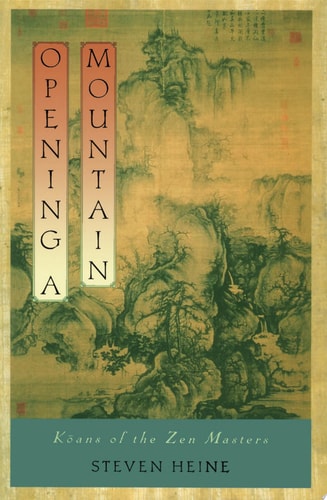
Opening a Mountain: Koans of the Zen Masters
0
0
As an Amazon Associate and affiliate partner, Menrva Books earns from qualifying purchases. Learn more
Author Description
With the growing popularity of Zen Buddhism in the West, virtually everyone knows, or thinks they know, what a koan is: a brief and baffling question or statement that cannot be solved by the logical mind and which, after sustained concentration, can lead to sudden enlightenment. But the truth about koans is both simpler--and more complicated--than this. In Opening a Mountain, Steven Heine shows that koans, and the questions we associate with them--such as "What is the sound of one hand clapping?"--are embedded in larger narratives and belong to an ancient Buddhist tradition of "encounter dialogues." These dialogues feature dramatic and often inscrutable contests between masters and disciples, or between masters and an array of natural and supernatural forces: rouge priests, "wild foxes," hermits, wizards, shapeshifters, magical animals, and dangerous women. To establish a new monastery, "to open a mountain," the Zen master had to tame these wild forces in regions most remote from civilization. In these extraordinary encounters, fingers and arms are cut off, pitchers are kicked over, masters appear in and interpret each other's dreams, and seemingly absurd statements are shown to reveal the deepest insights. Heine restores these koans to their original traditions, allowing readers to see both the complex elements of Chinese culture and religion that they reflect and the role they played in Zen's transformation of local superstitions into its own teachings. Offering a fresh approach to one of the most crucial elements of Zen Buddhism, Opening a Mountain is essential reading for anyone seeking to understand the full story behind koans and the mysterious worlds they come from.
Menrva's Summary
THE THESIS
This book investigates the historical and narrative origins of Zen koans to challenge the common perception of them as merely baffling, logic-defying riddles. Steven Heine, a scholar of East Asian religions, utilizes historical texts and Buddhist literature to argue that koans are deeply embedded in 'encounter dialogues' that reflect complex interactions between masters and the supernatural or natural world. By contextualizing these dialogues, the author demonstrates how Zen traditions transformed local folklore and superstition into structured religious teachings.
THE SCOPE MAP
What You Will Find
- Historical analysis of 'encounter dialogues' between Zen masters and disciples
- Exploration of supernatural elements including shapeshifters, wizards, and magical animals
- Contextualization of the 'opening a mountain' metaphor in monastery founding
- Examination of Chinese cultural influences on Zen development
Scope Limits
- Does not serve as a practical guide for meditation or personal koan practice
- Focuses primarily on historical and literary origins rather than contemporary psychological applications
THE AUTHORITY PERSPECTIVE
Experts recognize this work as a significant contribution to the academic study of Zen Buddhism by providing necessary historical depth to popular misconceptions. Readers frequently note the scholarly density of the prose, which is well-suited for those seeking a rigorous investigation into the origins of Buddhist traditions.
Page Count:
213
Publication Date:
2004-01-01
Publisher:
Oxford University Press
ISBN-10:
0190291737
ISBN-13:
9780190291730
Spirituality
Religion
Philosophy
History
Buddhism
Special Topics
Kindle Store
Sacred texts
Zen Buddhism
Zen
Kindle eBooks
Categories
Community Tags
Similar Books