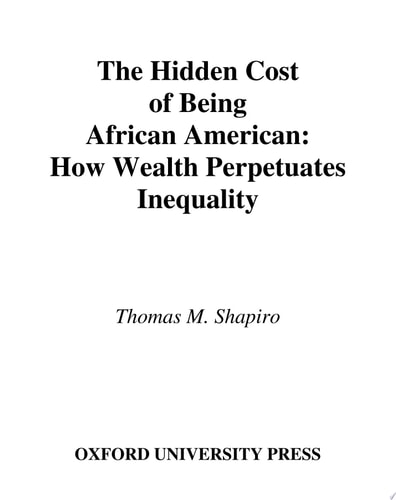
The Hidden Cost of Being African American: How Wealth Perpetuates Inequality
0
0
As an Amazon Associate and affiliate partner, Menrva Books earns from qualifying purchases. Learn more
Author Description
Thomas Shapiro blends personal stories, interviews, empirical data, and analysis to illuminate how family assets produce dramatic consequences in the everyday lives of ordinary citizens. This book will re-shape public understanding of racial inequality and will help us understand why new policies are necessary. Over the past three decades, racial prejudice in America has declined significantly and many African-American families have seen a steady rise in employment and annual income. Alongside these encouraging signs, Shapiro argues that fundamental levels of racial inequality persist, particularly in the area of asset accumulation. This book demonstrates how families use private wealth to leverage advantages in communities and schooling for themselves and their children. In this eye-opening volume, Shapiro uses a combination of in-depth interviews with almost 200 families from Los Angeles, Boston, and St. Louis, and national survey data with 10,000 families to show how racial inequality is passed down from generation to generation through the use of private family wealth. Shapiro adroitly illustrates the profound importance of assets--savings accounts, stocks, bonds, home equity, and other investments--to the past, present, and future lives of American families. For instance, young, white middle class-families typically purchase their first homes with substantial financial assistance from their extended family, and thus wealth accumulated from the past transforms opportunities into a substantial head start in life. This "wealthfare" is a legacy of past inequality visiting the present and may well project social injustice for generations into the future. An asset perspective, Shapiro shows, is a truer measure of the economic health of the black community--over half the black families fell below an asset poverty line in 1999. Moreover, an asset-based perspective, unlike currently used income-based approaches, gives insight into issues underlying debates ranging from education and housing to social security and tax reform.
Menrva's Summary
THE THESIS
This book investigates how the persistent disparity in private asset accumulation between white and African American families functions as a primary driver of systemic racial inequality. Thomas M. Shapiro, a professor of law and social policy, utilizes a comprehensive framework that shifts the focus from annual income to long-term wealth. By analyzing the role of intergenerational transfers, such as home equity and financial gifts, he argues that current economic policies fail to address the structural advantages that perpetuate social stratification across generations.
THE SCOPE MAP
What You Will Find
- Comparative analysis of asset accumulation between white and African American households.
- Examination of the role of intergenerational wealth transfers and family financial assistance.
- Qualitative data derived from in-depth interviews with nearly 200 families across three major U.S. cities.
- Quantitative insights from national survey data involving 10,000 families.
- Evaluation of how private wealth influences access to quality schooling and community resources.
THE AUTHORITY PERSPECTIVE
Experts and sociologists recognize this work as a foundational text for understanding the distinction between income-based and asset-based economic analysis. Readers frequently note the clarity with which the author connects historical policy legacies to contemporary financial outcomes for families.
Page Count:
256
Publication Date:
2004-02-05
Publisher:
Oxford University Press
ISBN-10:
019515147X
ISBN-13:
9780195151473
Economics
Sociology
Ethnic Studies
Social Science
Race Relations
African Americans
Public Policy
Community Tags
Similar Books








Reader Comments
Share Your Thoughts
No comments yet. Be the first to share your thoughts!