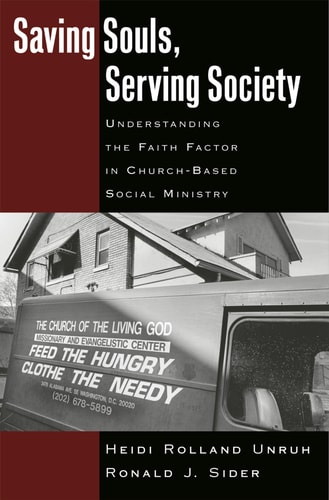
Saving Souls, Serving Society: Understanding the Faith Factor in Church-Based Social Ministry
0
0
As an Amazon Associate and affiliate partner, Menrva Books earns from qualifying purchases. Learn more
Author Description
Recent years have seen unprecedented attention to faith-based institutions as agents of social change, spurred in part by cuts in public funding for social services and accompanied by controversy about the separation of church and state. The debate over faith-based initiatives has highlighted a small but growing segment of churches committed to both saving souls and serving society. What distinguishes faith-based from secular activism? How do religious organizations express their religious identity in the context of social services? How do faith-based service providers interpret the connection between spiritual methodologies and socioeconomic outcomes? How does faith motivate and give meaning to social ministry? Drawing on case studies of fifteen Philadelphia-area Protestant churches with active outreach, Saving Souls, Serving Society seeks to answer these and other pressing questions surrounding the religious dynamics of social ministry. While church-based programs often look similar to secular ones in terms of goods or services rendered, they may show significant differences in terms of motivations, desired outcomes, and interpretations of meaning. Church-based programs also differ from one another in terms of how they relate evangelism to their social outreach agenda. Heidi Rolland Unruh and Ronald J. Sider explore how churches navigate the tension between their spiritual mission and the constraints on evangelism in the context of social services. The authors examine the potential contribution of religious dynamics to social outcomes as well as the relationship between mission orientations and social capital. Unruh and Sider introduce a new vocabulary for describing the religious components and spiritual meanings embedded in social action, and provide a typology of faith-based organizations and programs. Their analysis yields a framework for Protestant mission orientations that makes room for the diverse ways that churches interrelate spiritual witness and social
Menrva's Summary
THE THESIS
How do faith-based organizations reconcile the dual objectives of spiritual evangelism and secular social service provision? Heidi Rolland Unruh and Ronald J. Sider, both scholars of religion and social ministry, investigate the operational and ideological frameworks of Protestant churches engaged in community outreach. By analyzing the intersection of religious identity and social welfare, the authors provide a systematic typology to understand how spiritual motivations influence the delivery and outcomes of social programs.
THE SCOPE MAP
What You Will Find
- A detailed analysis of fifteen Protestant churches in the Philadelphia area.
- A new vocabulary and typology for categorizing faith-based social ministry models.
- Examination of the relationship between religious mission orientations and the development of social capital.
- A framework for understanding the tension between evangelistic goals and the constraints of public service provision.
THE AUTHORITY PERSPECTIVE
Experts in the field of sociology of religion identify this work as a foundational text for understanding the nuances of faith-based social initiatives. Readers frequently note the academic rigor of the authors' typology, which provides a necessary structure for evaluating the effectiveness and distinctiveness of religious service providers.
Page Count:
356
Publication Date:
2005-10-06
Publisher:
Oxford University Press
ISBN-10:
0195161556
ISBN-13:
9780195161557
Religion
Church Work
Worship & Devotion
Social Work
Kindle eBooks
Theology
Sociology
Categories
Christian Living
Kindle Store
Public Policy
Community Tags
Similar Books












Reader Comments
Share Your Thoughts
No comments yet. Be the first to share your thoughts!