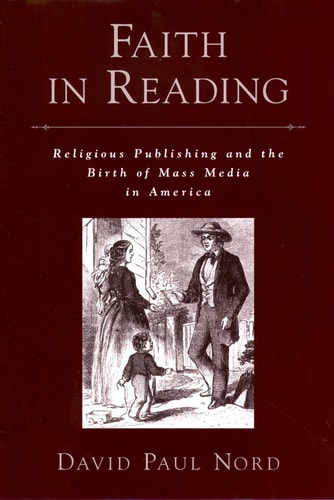
Faith in Reading: Religious Publishing and the Birth of Mass Media in America
0
0
As an Amazon Associate and affiliate partner, Menrva Books earns from qualifying purchases. Learn more
Author Description
In the twenty-first century, mass media corporations are often seen as profit-hungry money machines. It was a different world in the early days of mass communication in America. Faith in Reading tells the remarkable story of the noncommercial religious origins of our modern media culture. In the early nineteenth century, a few visionary entrepreneurs decided the time was right to reach everyone in America through the medium of print. Though they were modern businessmen, their publishing enterprises were not commercial businesses but nonprofit societies committed to the publication of traditional religious texts. Drawing on organizational reports and archival sources, David Paul Nord shows how the managers of Bible and religious tract societies made themselves into large-scale manufacturers and distributors of print. These organizations believed it was possible to place the same printed message into the hands of every man, woman, and child in America. Employing modern printing technologies and business methods, they were remarkably successful, churning out millions of Bibles, tracts, religious books, and periodicals. They mounted massive campaigns to make books cheap and plentiful by turning them into modern, mass-produced consumer goods. Nord demonstrates how religious publishers learned to work against the flow of ordinary commerce. They believed that reading was too important to be left to the "market revolution," so they turned the market on its head, seeking to deliver their product to everyone, regardless of ability or even desire to buy. Wedding modern technology and national organization to a traditional faith in reading, these publishing societies imagined and then invented mass media in America.
Menrva's Summary
THE THESIS
This book investigates how early nineteenth-century religious nonprofit societies pioneered the infrastructure and distribution methods that birthed modern American mass media. David Paul Nord, a scholar of media history, utilizes organizational reports and archival records to trace the evolution of Bible and tract societies. He argues that these organizations, driven by a mission to disseminate religious texts to every citizen, effectively invented the logistical and technological frameworks of mass communication before the rise of purely commercial media corporations.
THE SCOPE MAP
What You Will Find
- Analysis of the transition from traditional printing to large-scale mass production of religious texts.
- Examination of the organizational structures of early nineteenth-century Bible and tract societies.
- Use of primary source archival data and organizational reports to track distribution networks.
- Exploration of the ideological conflict between religious mission-driven publishing and the emerging market revolution.
THE AUTHORITY PERSPECTIVE
Scholars and historians recognize this work as a significant contribution to the study of American media origins and the intersection of religion and commerce. Readers frequently note the academic rigor of the research and the clarity with which Nord connects early religious publishing to contemporary mass media structures.
Page Count:
222
Publication Date:
2004-08-19
Publisher:
Oxford University Press
ISBN-10:
0195173112
ISBN-13:
9780195173116
Religion
History
Kindle Store
American History
Media Studies
Business & Professional
Kindle eBooks
Publishing
Writing Guides
Christian Living
Worship & Devotion
Church History
Americas
Christians
Categories
Words Language & Grammar
Tract Societies
Church Leadership
Reference
Linguistics