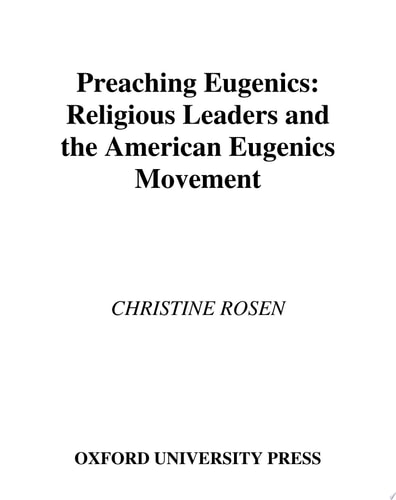
Preaching Eugenics: Religious Leaders and the American Eugenics Movement
0
0
As an Amazon Associate and affiliate partner, Menrva Books earns from qualifying purchases. Learn more
Author Description
With our success in mapping the human genome, the possibility of altering our genetic futures has given rise to difficult ethical questions. Although opponents of genetic manipulation frequently raise the specter of eugenics, our contemporary debates about bioethics often take place in a historical vacuum. In fact, American religious leaders raised similarly challenging ethical questions in the first half of the twentieth century. Preaching Eugenics tells how Protestant, Catholic, and Jewish leaders confronted and, in many cases, enthusiastically embraced eugenics-a movement that embodied progressive attitudes about modern science at the time. Christine Rosen argues that religious leaders pursued eugenics precisely when they moved away from traditional religious tenets. The liberals and modernists-those who challenged their churches to embrace modernity-became the eugenics movement's most enthusiastic supporters. Their participation played an important part in the success of the American eugenics movement. In the early twentieth century, leaders of churches and synagogues were forced to defend their faiths on many fronts. They faced new challenges from scientists and intellectuals; they struggled to adapt to the dramatic social changes wrought by immigration and urbanization; and they were often internally divided by doctrinal controversies among modernists, liberals, and fundamentalists. Rosen draws on previously unexplored archival material from the records of the American Eugenics Society, religious and scientific books and periodicals of the day, and the personal papers of religious leaders such as Rev. John Haynes Holmes, Rev. Harry Emerson Fosdick, Rev. John M. Cooper, Rev. John A. Ryan, and biologists Charles Davenport and Ellsworth Huntington, to produce an intellectual history of these figures that is both lively and illuminating. The story of how religious leaders confronted one of the era's newest "sciences," eugenics, sheds important new light on a time of profound social and religious change.
Menrva's Summary
THE THESIS
This book investigates the historical intersection between American religious leadership and the eugenics movement during the early twentieth century. Christine Rosen, a scholar of history and ethics, examines how Protestant, Catholic, and Jewish leaders navigated the tension between traditional theology and the rise of modern scientific progress. By analyzing archival records and personal correspondence, the author argues that liberal and modernist religious figures were instrumental in legitimizing eugenic policies as a means of addressing social instability and urbanization.
THE SCOPE MAP
What You Will Find
- Historical analysis of the American eugenics movement from 1900 to 1950.
- Examination of the ideological shift among liberal religious leaders toward scientific modernism.
- Primary source research including records from the American Eugenics Society and personal papers of prominent clergy.
- Case studies on the influence of religious figures such as John Haynes Holmes and John A. Ryan.
THE AUTHORITY PERSPECTIVE
Experts recognize this work as a significant contribution to the history of American religious thought and its complex relationship with scientific movements. Readers frequently note the meticulous archival research that provides a nuanced view of how religious institutions adapted to the social pressures of the early twentieth century.
Page Count:
296
Publication Date:
2004-01-01
Publisher:
Oxford University Press
ISBN-10:
0198035640
ISBN-13:
9780198035640
Science
History
Religion
Eugenics
Reference
Americas
Christian Living
Kindle Store
Sociology
Ethics
Church Leadership
Church History
Preaching
Categories
Linguistics
Kindle eBooks
Words Language & Grammar
Community Tags
Similar Books



Reader Comments
Share Your Thoughts
No comments yet. Be the first to share your thoughts!