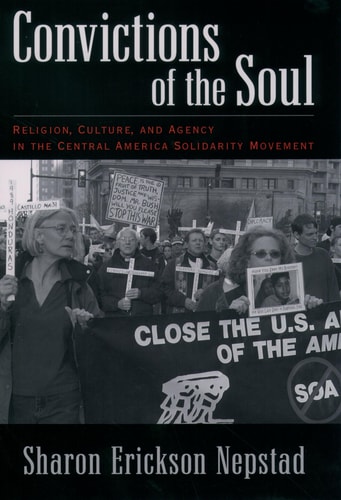
Convictions of the Soul: Religion, Culture, and Agency in the Central America Solidarity Movement
0
0
As an Amazon Associate and affiliate partner, Menrva Books earns from qualifying purchases. Learn more
Author Description
Many U.S. Christians were profoundly moved by the liberation struggles in Central America in the 1980s. Most learned about the situation from missionaries who had worked in the area and witnessed the repression firsthand. These missionaries, Sharon Erickson Nepstad shows, employed the institutional and cultural resources of Christianity to seize the attention of American congregations and remind them of the moral obligations of their faith. Drawing on archival data and in-depth interviews with activists in ten separate solidarity organizations around the country, Nepstad offers a rich analysis of the experiences of religious leaders and church members in the solidarity movement. She explores the moral meaning of protest and the ways in which clergy used religious rituals, martyr stories, and biblical teachings to establish a link between faith and activism. She looks at the factors that transformed missionaries into skilled leaders who were able to translate the Central American conflicts into Christian themes and a religious language familiar to U.S. congregations. She also offers insights into the unique challenges of organizing on the transnational level and shows how the solidarity movement made U.S. policy towards Central America one of the most hotly contested issues in American politics during the 1980s. Unpacking the implications of her study for the field of collective action, Nepstad stresses the importance of the individual human agents who shape, and are shaped by, the structures and cultures in which they operate. She argues that working in and through the church gave supporters of solidarity moral credibility as well as a rich source of symbolic, human, and material resources that enabled them to reach across national boarders, motivating others to act upon their deeply held moral convictions. Shedding new light on the genesis and evolution of this important activist movement, Convictions of the Soul will be of interest to students and scholars of sociology.
Menrva's Summary
THE THESIS
This work investigates how religious institutions and cultural frameworks facilitated the mobilization of U.S. Christians within the Central America solidarity movement during the 1980s. Sharon Erickson Nepstad, a sociologist specializing in social movements, utilizes archival research and qualitative interviews to analyze how activists translated foreign political conflicts into moral imperatives for American congregations. She argues that the church provided a unique infrastructure of symbolic and material resources that allowed individuals to bridge national divides and influence U.S. foreign policy.
THE SCOPE MAP
What You Will Find
- Analysis of ten distinct solidarity organizations operating across the United States.
- Examination of how religious rituals, martyr narratives, and biblical exegesis were employed to frame political protest.
- Primary source data derived from in-depth interviews with clergy and lay activists.
- A theoretical framework exploring the intersection of individual agency and institutional structures in collective action.
THE AUTHORITY PERSPECTIVE
Scholars in the field of social movement theory identify this text as a significant contribution to the study of religious activism and transnational organizing. Readers frequently note the clarity of the author's sociological analysis and the effectiveness of her focus on the role of individual agents in shaping political discourse.
Page Count:
224
Publication Date:
2004-07-22
Publisher:
Oxford University Press
ISBN-10:
0195169239
ISBN-13:
9780195169232
History
Religion
Insurgency
Central America
Missionaries
International Affairs
Sociology
Solidarity
Community Tags
Similar Books










Reader Comments
Share Your Thoughts
No comments yet. Be the first to share your thoughts!