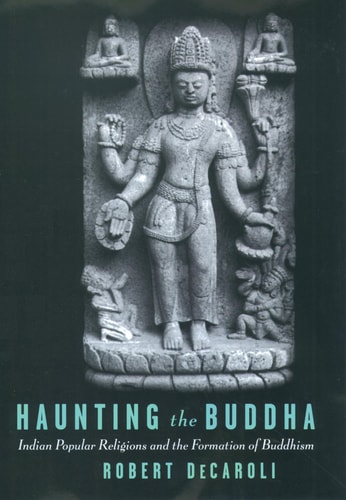
Haunting the Buddha: Indian Popular Religions and the Formation of Buddhism
0
0
As an Amazon Associate and affiliate partner, Menrva Books earns from qualifying purchases. Learn more
Author Description
Early European histories of India frequently reflected colonialist agendas. The idea that Indian society had declined from an earlier Golden Age helped justify the colonial presence. It was said, for example, that modern Buddhism had fallen away from its original identity as a purely rational philosophy that arose in the mythical 5th-century BCE Golden Age unsullied by the religious and cultural practices that surrounded it. In this book Robert DeCaroli seeks to place the formation of Buddhism in its appropriate social and political contexts. It is necessary, he says, to acknowledge that the monks and nuns who embodied early Buddhist ideals shared many beliefs held by the communities in which they were raised. In becoming members of the monastic society these individuals did not abandon their beliefs in the efficacy and the dangers represented by minor deities and spirits of the dead. Their new faith, however, gave them revolutionary new mechanisms with which to engage those supernatural beings. Drawing on fieldwork, textual, and iconographic evidence, DeCaroli offers a comprehensive view of early Indian spirit-religions and their contributions to Buddhism-the first attempt at such a study since Ananda Coomaraswamy's pioneering work was published in 1928. The result is an important contribution to our understanding of early Indian religion and society, and will be of interest to those in the fields of Buddhist studies, Asian history, art history, and anthropology.
Menrva's Summary
THE THESIS
This book investigates how early Buddhist practitioners integrated indigenous spirit-religions into their faith, challenging the colonial narrative that Buddhism was a purely rational philosophy isolated from its cultural environment. Robert DeCaroli, a scholar of early Indian religion, utilizes a multidisciplinary approach to recontextualize the formation of Buddhism. By examining the intersection of monastic life and local supernatural beliefs, he argues that early Buddhists actively engaged with, rather than rejected, the minor deities and spirits prevalent in their communities. The work provides a framework for understanding how these religious interactions shaped the development of Buddhist practice and iconography.
THE SCOPE MAP
What You Will Find
- Analysis of early Indian spirit-religions and their influence on Buddhist doctrine.
- Examination of iconographic evidence from ancient Indian sites.
- Integration of textual analysis and field research to map religious syncretism.
- Historical critique of colonialist interpretations of Indian religious decline.
THE AUTHORITY PERSPECTIVE
Scholars recognize this work as a significant update to the foundational studies of the early 20th century, providing a more nuanced view of religious interaction in ancient India. Readers frequently note the academic density of the prose, which makes it a specialized resource for students and researchers in Buddhist studies and anthropology.
Page Count:
240
Publication Date:
2004-09-30
Publisher:
Oxford University Press
ISBN-10:
0195168380
ISBN-13:
9780195168389
Religion
History
Buddhism
Art History
Anthropology
Buddhism india
Buddhist Art
Buddhist Gods
Asian Studies
Community Tags
Similar Books