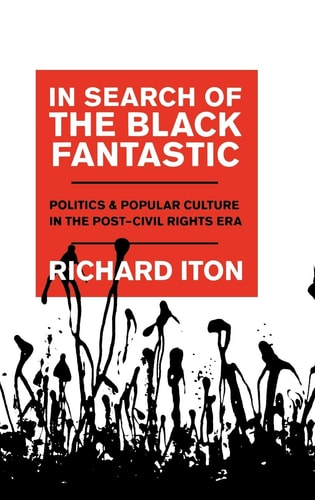
In Search of the Black Fantastic: Politics and Popular Culture in the Post-Civil Rights Era
0
0
As an Amazon Associate and affiliate partner, Menrva Books earns from qualifying purchases. Learn more
Author Description
Prior to the 1960s, when African Americans had little access to formal political power, black popular culture was commonly seen as a means of forging community and effecting political change.But as Richard Iton shows in this provocative and insightful volume, despite the changes brought about by the civil rights movement, and contrary to the wishes of those committed to narrower conceptions of politics, black artists have continued to play a significant role in the making and maintenance of critical social spaces. Iton offers an original portrait of the relationship between popular culture and institutionalized politics tracing the connections between artists such as Paul Robeson, Lorraine Hansberry, Richard Pryor, Bob Marley, and Erykah Badu and those individuals working in the protest, electoral, and policy making arenas. With an emphasis on questions of class, gender and sexuality-and diaspora and coloniality-the author also illustrates how creative artists destabilize modern notions of the proper location of politics, and politics itself.Ranging from theater to film, and comedy to literature and contemporary music, In Search of the Black Fantastic is an engaging and sophisticated examination of how black popular culture has challenged our understandings of the aesthetic and its relationship to politics.
Menrva's Summary
THE THESIS
This volume investigates how black popular culture functions as a critical site of political expression and social resistance in the post-civil rights era. Richard Iton, a scholar of political science and African American studies, challenges the traditional separation between institutional politics and creative expression. By analyzing the work of artists ranging from Paul Robeson to Erykah Badu, he argues that cultural production serves as a vital, often overlooked, mechanism for political engagement and community formation.
THE SCOPE MAP
What You Will Find
- Analysis of the intersection between institutionalized politics and artistic output.
- Examination of class, gender, sexuality, diaspora, and coloniality within black cultural spaces.
- Case studies of influential figures including Lorraine Hansberry, Richard Pryor, and Bob Marley.
- A multidisciplinary framework spanning theater, film, comedy, literature, and music.
THE AUTHORITY PERSPECTIVE
Scholars and critics recognize this work as a foundational text for understanding the political dimensions of black popular culture. Readers frequently note the academic density of the prose, which provides a rigorous theoretical framework for analyzing the aesthetic as a political tool.
Page Count:
422
Publication Date:
2008-06-06
Publisher:
Oxford University Press
ISBN-10:
0195178467
ISBN-13:
9780195178463
Politics
History
Kindle eBooks
Categories
Specific Topics
African Americans
United States
Ethnic Studies
Kindle Store
Race Relations
Sociology
Americas
Community Tags
Similar Books