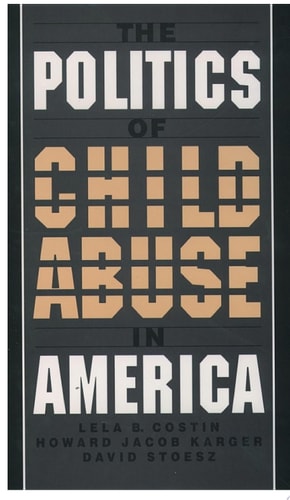
The Politics of Child Abuse in America
0
0
As an Amazon Associate and affiliate partner, Menrva Books earns from qualifying purchases. Learn more
Author Description
Child abuse policy in the United States contains dangerous contradictions, which have only intenstified as the public slowly accepted it as a middle class problem. One contradiction is the rapidly expanding child abuse industry (made up of enterprising psychotherapists and attorneys) which is consuming enormous resources, while thousands of poor children are seriously injured or killed, many while being "protected" by public agencies. This "rediscovery" has also led to the frenzied pursuit of offenders, resulting in the sacrifice of some innocent people. Moreover, the media's focus on the sensational details of high-visibility sexual abuse cases has helped to trivialize, if not commercialize, the child abuse problem. As such, child abuse has gone from a social problem to a social spectacle. By the 1980s the child welfare system had become a virtual "nonsystem," marked by a staggering turnover of staff, unmanageable caseloads, a severe shortage of funding, and caseloads composed of highly dysfunctional families (many with drug-related problems). To make room for these families, public agencies rationed services by increasingly screening-out child abuse reports which contained little likelihood of serious bodily harm. In The Politics of Child Abuse in America, the authors argue that child abuse must be viewed as a public safety problem. This redefinition would make it congruent with other family-based social trends, including the crackdown on domestic violence. Children must have the same legal protection currently extended to physically and sexually abused women. This can be done by creating a "Children's Authority," which would have the overall charge for protecting children. Specifically, Children's Authorities would have the responsibility for providing the six main functions of child protection: investigation, enforcement, placement services, prevention and education, family support, and research and development. Offering a unique perspective on the cold reality
Menrva's Summary
THE THESIS
This book investigates the systemic failures and contradictions within the American child welfare system, arguing that child abuse should be reclassified as a public safety issue rather than merely a social problem. The authors, Howard Jacob Karger, Lela B. Costin, and David Stoesz, utilize historical analysis and policy critique to demonstrate how the current child welfare apparatus has become a dysfunctional entity that prioritizes sensationalism and bureaucratic survival over the actual protection of vulnerable children. They propose a structural overhaul through the creation of a centralized 'Children's Authority' to standardize protection, enforcement, and family support services.
THE SCOPE MAP
What You Will Find
- Analysis of the 'child abuse industry' and the role of private practitioners in public policy.
- Critique of media influence on the public perception of child abuse cases.
- Evaluation of systemic issues including staff turnover, funding shortages, and caseload management.
- A proposal for a 'Children's Authority' to consolidate child protection functions.
Scope Limits
- The text focuses primarily on the American child welfare system during the 1980s and early 1990s.
- It does not provide an exhaustive global comparison of child protection models.
THE AUTHORITY PERSPECTIVE
Experts in social work and public policy frequently cite this work for its critical examination of the institutionalization of child protection services. Readers often note the academic density of the prose and the provocative nature of the authors' proposed structural reforms.
Page Count:
205
Publication Date:
1997-01-01
Publisher:
Oxford University Press
ISBN-10:
0190283459
ISBN-13:
9780190283452
Politics
History
Child Abuse
Kindle eBooks
Americas
Introduction to Social WorkWelfare
Family relationships
Abuse
Categories
Child Welfare
Kindle Store
Public Policy
Social Science
Sociology
Community Tags
Similar Books







Reader Comments
Share Your Thoughts
No comments yet. Be the first to share your thoughts!