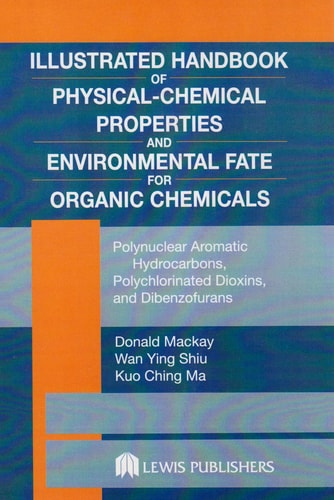
Illustrated Handbook of Physical-Chemical Properties and Environmental Fate for Organic Chemicals Volume 2
0
0
As an Amazon Associate and affiliate partner, Menrva Books earns from qualifying purchases. Learn more
Author Description
Illustrated Handbook of Physical-Chemical Properties and Environmental Fate for Organic Chemicals is a comprehensive series in five volumes that focuses on environmental fate prediction and quantitative structure activity relationship analysis. Volume II examines the properties and environmental fate of three classes of important series of chemicals: polycyclic aromatic hydrocarbons (about 40 chemical compounds), highly toxic chlorinated "dioxins," and equally toxic chlorinated dibenzofurans, which are similar to dioxins in structure and toxicity. What is Different About These Books? These books are like no others in that they tackle environmental fate calculations and QSAR Plots. Environmental partitioning and persistence are calculated in a generic "unit world" using standard fugacity models. This shows where the chemicals will go, relative concentrations, persistence, and important intermedia transport processes. From this information, a behavior profile emerges that can be presented in a standard format. For the series of chemicals presented, QSAR Plots can be prepared by plotting these properties against molecular descriptors (e.g., carbon number, chlorine number, molar number) and relationships between properties can be explored. This helps validate the data and estimates of properties for other chemicals can be made from these plots.
Menrva's Summary
THE THESIS
This handbook provides a detailed analysis of the physical-chemical properties and environmental fate of specific organic chemical classes. Volume II focuses on polycyclic aromatic hydrocarbons, chlorinated dioxins, and chlorinated dibenzofurans, examining approximately 40 chemical compounds. It uniquely integrates environmental fate calculations and Quantitative Structure-Activity Relationship (QSAR) plots to predict chemical behavior, partitioning, and persistence within a standardized framework.
THE SCOPE MAP
- Detailed examination of polycyclic aromatic hydrocarbons (PAHs) with approximately 40 chemical compounds.
- In-depth analysis of highly toxic chlorinated dioxins.
- Comprehensive study of chlorinated dibenzofurans, noting their structural and toxicological similarities to dioxins.
- Application of fugacity models in a generic 'unit world' to calculate environmental partitioning and persistence.
- Presentation of chemical behavior profiles in a standard format.
- Preparation of QSAR plots by correlating properties with molecular descriptors (e.g., carbon number, chlorine number, molar number).
- Exploration of relationships between chemical properties to validate data and estimate properties for other chemicals.
THE AUTHORITY PERSPECTIVE
This volume is part of a comprehensive five-volume series dedicated to environmental fate prediction and QSAR analysis. The series distinguishes itself by integrating complex calculations and predictive modeling, offering a unique approach to understanding chemical behavior in the environment. The methodology employed, utilizing fugacity models and QSAR plots, provides a systematic way to assess partitioning, persistence, and transport processes. This approach aids in data validation and the estimation of properties for related chemical compounds.
Page Count:
608
Publication Date:
1992-07-21
Publisher:
CRC-Press
ISBN-10:
0873715837
ISBN-13:
9780873715836
Non-Fiction
Science
Chemistry
Reference
Toxicology
Community Tags
Similar Books