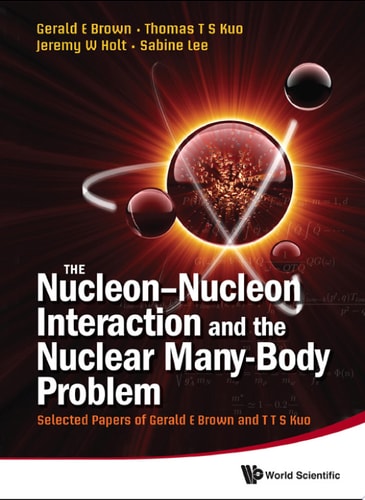
The Nucleon-nucleon Interaction and the Nuclear Many-body Problem: Selected Papers of Gerald E. Brown and T.T.S. Kuo
0
0
As an Amazon Associate and affiliate partner, Menrva Books earns from qualifying purchases. Learn more
Author Description
This book provides a comprehensive overview of some key developments in the understanding of the nucleon-nucleon interaction and nuclear many-body theory. The main problems at the level of meson exchange physics have largely been solved, and we now have an effective nucleon-nucleon interaction, pioneered in a renormalization group formalism by several of us at Stony Brook and our colleagues at Naples, which is nearly universally accepted as the unique low-momentum interaction that includes all experimental information to date.Our present understanding of these issues is based on a multi-step development in which different scientific insights and a wide range of physical and mathematical methodologies fed into each other. It is best appreciated by looking at the?steps along the way?, starting with the pioneering work of Brueckner and his collaborators that was just as necessary and important as the insightful improvements to Brueckner's theory by Hans Bethe and his students. Moving on from there, microscopic methods for nuclear structure calculations using the Brueckner G-matrix, and later low-momentum nucleon interactions, were developed and applied. With their influential 1967 paper, Brown and Kuo prepared the effective theory that allowed the description of nuclear properties directly from the underlying nucleon-nucleon interaction. Later, the addition of?Brown-Rho scaling? to the one-boson-exchange model deepened the understanding of nuclear matter saturation, carbon-14 dating and the structure of neutron stars.
Menrva's Summary
THE THESIS
This collection explores the foundational developments in understanding the nucleon-nucleon interaction and nuclear many-body theory. The work presented, particularly the effective nucleon-nucleon interaction developed through renormalization group formalism, is now widely accepted for its comprehensive inclusion of experimental data. The book traces a multi-step evolution of scientific insights and methodologies, beginning with Brueckner's pioneering work and progressing through Bethe's improvements and the application of microscopic methods. The influential 1967 paper by Brown and Kuo is highlighted for establishing a theoretical framework to describe nuclear properties directly from the underlying interaction, with later contributions like 'Brown-Rho scaling' further advancing the understanding of nuclear matter and neutron stars.
THE SCOPE MAP
- Key developments in the nucleon-nucleon interaction and nuclear many-body theory.
- The renormalization group formalism for effective nucleon-nucleon interactions.
- Historical progression from Brueckner's theory to modern methods.
- Microscopic methods for nuclear structure calculations using the Brueckner G-matrix.
- The theoretical framework for describing nuclear properties directly from the underlying interaction.
- The impact of 'Brown-Rho scaling' on nuclear matter saturation and neutron star structure.
THE AUTHORITY PERSPECTIVE
This collection represents a significant compilation of seminal works in nuclear physics, particularly focusing on the contributions of Gerald E. Brown and T.T.S. Kuo. The papers included are foundational to the modern understanding of the nucleon-nucleon interaction and nuclear many-body problem, reflecting a critical period of theoretical development. The text is likely to be highly valued by researchers and advanced students in theoretical nuclear physics for its direct access to these influential studies. The compilation serves as a testament to the collaborative and evolutionary nature of scientific progress in this field.
Page Count:
597
Publication Date:
2010-01-01
Publisher:
World Scientific
ISBN-10:
9814289280
ISBN-13:
9789814289283
Non-Fiction
Science
Collected works
Nuclear Physics
Theoretical Physics
Physics
Community Tags
Similar Books