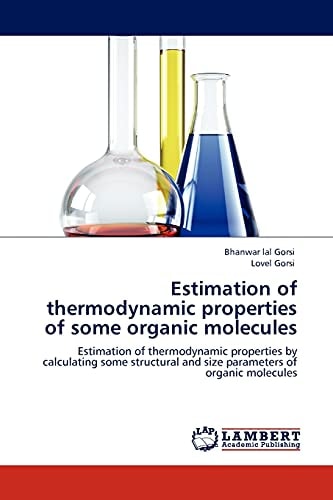
Estimation of Thermodynamic Properties of Some Organic Molecules
0
0
As an Amazon Associate and affiliate partner, Menrva Books earns from qualifying purchases. Learn more
Author Description
Experimental measurements of some thermodynamic parameters involve experimental difficulties and the corresponding methods possess real drawbacks. Consequently, it is necessary to resort to a theoretical calculation of these parameters. Literature reveals that the first order valence connectivity (1χv ) van der waals volume (vW), electrotopological state index ( E ) and refractotopological state index (R ), the important structural, size and electronic parameters have been found to be one of the most fundamental characteristics of the physical properties of organic molecules.In the present study, the thermodynamic properties, e.g., standard specific heat capacities (Cpo), standard entropy (So), change of standard Gibb's free energy (∆Gfo), change of enthalpy of formation (∆Hf 0), enthalpy of vaporization (∆Hv), enthalpy of sublimation (∆Hs ) and enthalpy of melting (∆Hm ) have been found to be significantly correlated with the size, structural and electronic parameters, with the above structural, size and electronic parametersTherefore, these structural, size and electronic parameters can be used for the theoretically estimation of the above thermodynamic properties.
Menrva's Summary
THE THESIS
This study investigates the theoretical estimation of thermodynamic properties for organic molecules, addressing the challenges and drawbacks of experimental measurement. The authors, Bhanwar Lal Gorsi and Lovel Gorsi, utilize established structural, size, and electronic parameters—specifically first-order valence connectivity (1χv), van der Waals volume (vW), electrotopological state index (E), and refractotopological state index (R)—to establish significant correlations with key thermodynamic properties. These properties include standard specific heat capacities (Cpo), standard entropy (So), change of standard Gibb's free energy (∆Gfo), change of enthalpy of formation (∆Hf 0), enthalpy of vaporization (∆Hv), enthalpy of sublimation (∆Hs), and enthalpy of melting (∆Hm). The research posits that these fundamental molecular characteristics can serve as reliable predictors for these thermodynamic values.
THE SCOPE MAP
- Correlation between molecular structural, size, and electronic parameters (1χv, vW, E, R) and thermodynamic properties.
- Theoretical estimation methods for standard specific heat capacities (Cpo).
- Theoretical estimation methods for standard entropy (So).
- Theoretical estimation methods for change of standard Gibb's free energy (∆Gfo).
- Theoretical estimation methods for change of enthalpy of formation (∆Hf 0).
- Theoretical estimation methods for enthalpy of vaporization (∆Hv).
- Theoretical estimation methods for enthalpy of sublimation (∆Hs).
- Theoretical estimation methods for enthalpy of melting (∆Hm).
THE AUTHORITY PERSPECTIVE
This work presents a focused computational chemistry study, likely appealing to researchers and advanced students in physical and organic chemistry. The methodology relies on established indices and their correlation with thermodynamic data, suggesting a rigorous, data-driven approach. The scope appears to be the theoretical prediction of key thermodynamic values for organic molecules, offering an alternative to potentially difficult experimental measurements. The research aims to provide a framework for estimating these properties based on molecular structure.
Page Count:
144
Publication Date:
2011-07-01
Publisher:
Lap Lambert Academic Publishing GmbH KG
ISBN-10:
3845402830
ISBN-13:
9783845402833
Non-Fiction
Science
Chemistry
Physical Chemistry
Thermodynamics
Computational Chemistry
Community Tags
Similar Books