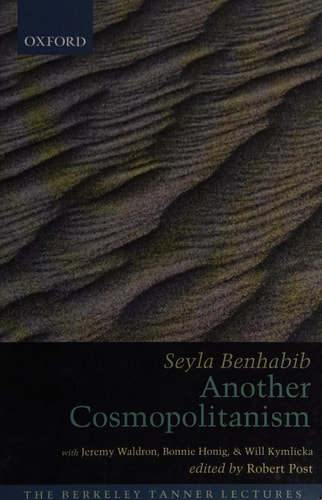
Another Cosmopolitanism: The Berkeley Tanner Lectures
0
0
As an Amazon Associate and affiliate partner, Menrva Books earns from qualifying purchases. Learn more
Author Description
In these two important lectures, distinguished political philosopher Seyla Benhabib argues that since the UN Declaration of Human Rights in 1948, we have entered a phase of global civil society which is governed by cosmopolitan norms of universal justice--norms which are difficult for some to accept as legitimate since they are sometimes in conflict with democratic ideals. In her first lecture, Benhabib argues that this tension can never be fully resolved, but it can be mitigated through the renegotiation of the dual commitments to human rights and sovereign self-determination. Her second lecture develops this idea in detail, with special reference to recent developments in Europe (for example, the banning of Muslim head scarves in France). The EU has seen the replacement of the traditional unitary model of citizenship with a new model that disaggregates the components of traditional citizenship, making it possible to be a citizen of multiple entities at the same time.The volume also contains a substantive introduction by Robert Post, the volume editor, and contributions by Bonnie Honig (Northwestern University), Will Kymlicka (Queens University), and Jeremy Waldron (Columbia School of Law).
Menrva's Summary
THE THESIS
This work investigates the inherent tension between universal human rights norms and the democratic principle of sovereign self-determination in the era of global civil society. Seyla Benhabib, a prominent political philosopher, utilizes the framework of the UN Declaration of Human Rights to analyze how modern states navigate the conflict between global justice and local democratic legitimacy. She argues that this tension is not a problem to be solved, but a condition to be managed through the continuous renegotiation of political identity and citizenship.
THE SCOPE MAP
What You Will Find
- Analysis of the evolution of global civil society since 1948
- Examination of the disaggregation of traditional citizenship models in the European Union
- Case studies regarding the regulation of religious expression in secular states
- Scholarly responses and critiques from political theorists Bonnie Honig, Will Kymlicka, and Jeremy Waldron
THE AUTHORITY PERSPECTIVE
Scholars and students of political theory frequently cite this volume as a foundational text for understanding the complexities of contemporary cosmopolitanism. Readers often note the academic density of the prose, which requires a strong background in legal and political philosophy to fully appreciate the arguments presented.
Page Count:
224
Publication Date:
2006-11-09
Publisher:
Oxford University Press
ISBN-10:
0195183223
ISBN-13:
9780195183221
Human rights
Citizenship
Political Philosophy
Law
International relations
Law Philosophy
Sociology
Community Tags
Similar Books