
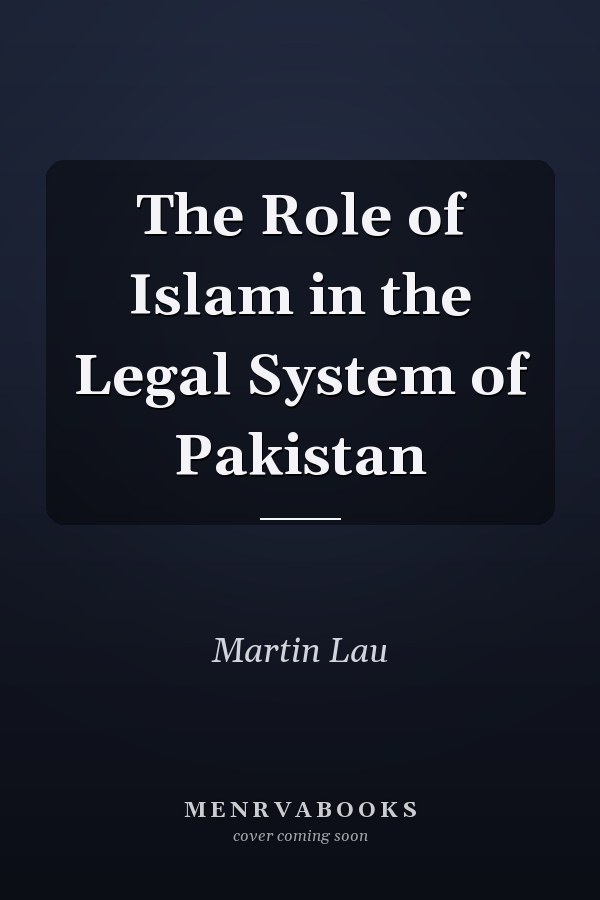
The Role of Islam in the Legal System of Pakistan
0
0
As an Amazon Associate and affiliate partner, Menrva Books earns from qualifying purchases. Learn more
Author Description
The role of the judiciary in the Islamisation of Pakistan's legal system has not received much attention by legal scholars. This book aims to fill this gap. Starting in 1947, it examines the way Pakistani judges have dealt with the controversial issue of Islam in the past 50 years. The book's focus on reported case-law offers a new perspective on the Islamisation of Pakistan's legal system in which Islam emerges as more than just a challenge to Western conceptions of human rights. The first part examines the emergence of Islamic arguments in the period up to 1977 when General Zia ul Haq embarked on an ambitious project to turn Pakistan into a truly Islamic state. In these early years of Pakistan judges increasingly turned to Islam as a source of law to preserve judicial independence and to protect the country's faltering democracy. The second part examines in detail the features and effects of Zia's Islamisation programme especially the workings of the newly created Federal Shariat Court. The third part reviews the legal developments in the post-Zia period when the judicial gates of Islamization which were first wide opened, have gradually been closed by a series of landmark decisions. What emerges from this analysis is an image of Islam as a source of law which is rich, complex and varied. Depending on the judge and the court, Islam was applied to varying effects ranging from liberal to extremely conservative attitudes. However, they share a common feature, namely that the role of Islam in the legal system of Pakistan is to a large degree determined by its higher judiciary.
Menrva's Summary
THE THESIS
This book investigates the complex and often contradictory role of Islam within Pakistan's legal system over the past fifty years, focusing specifically on the judiciary's influence. Martin Lau, a legal scholar, examines how Pakistani judges have interpreted and applied Islamic principles in law since the nation's inception in 1947. The analysis is grounded in reported case-law, offering a unique perspective on the Islamization process. The book argues that Islam has served not only as a challenge to Western legal concepts but also as a tool for preserving judicial independence and democratic ideals, with its application varying significantly based on the judge and court.
THE SCOPE MAP
- The evolution of Islamic legal arguments in Pakistan from 1947 to 1977, highlighting their use in maintaining judicial independence and protecting democracy.
- A detailed examination of General Zia ul Haq's Islamization program, including the establishment and function of the Federal Shariat Court.
- Analysis of legal developments post-Zia, focusing on landmark decisions that have gradually curtailed the scope of Islamization.
- Case studies demonstrating the diverse interpretations of Islamic law by the Pakistani judiciary, ranging from liberal to conservative.
- An exploration of Islam as a rich, complex, and varied source of law, shaped significantly by the higher judiciary.
THE AUTHORITY PERSPECTIVE
This work is recognized for its novel approach, centering on judicial decisions to illuminate the Islamization of Pakistan's legal system. By focusing on case-law, Lau provides a nuanced view that moves beyond simplistic interpretations of Islam as solely a challenge to human rights. The analysis reveals a dynamic and varied application of Islamic legal principles, underscoring the judiciary's pivotal role in shaping the legal landscape. The book's detailed review of different historical periods offers a comprehensive understanding of the evolving relationship between Islam and law in Pakistan.
Page Count:
247
Publication Date:
2006-01-01
Publisher:
BRILL
ISBN-10:
9004149279
ISBN-13:
9789004149274
Non-Fiction
Politics
Religion
History
Law
Community Tags
Other Editions(3)
Similar Books





Reader Comments
Share Your Thoughts
No comments yet. Be the first to share your thoughts!