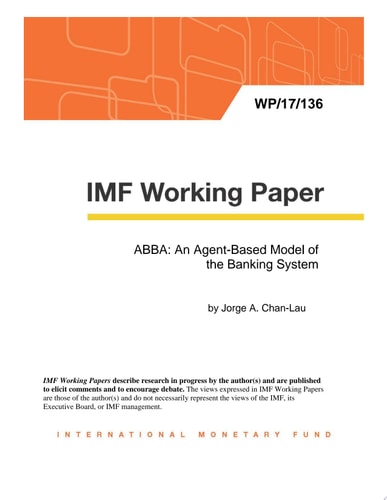
ABBA: An Agent-Based Model of the Banking System
0
0
As an Amazon Associate and affiliate partner, Menrva Books earns from qualifying purchases. Learn more
Author Description
A thorough analysis of risks in the banking system requires incorporating banks’ inherent heterogeneity and adaptive behavior in response to shocks and changes in business conditions and the regulatory environment. ABBA is an agent-based model for analyzing risks in the banking system in which banks’ business decisions drive the endogenous formation of interbank networks. ABBA allows for a rich menu of banks’ decisions, contingent on banks’ balance sheet and capital position, including dividend payment rules, credit expansion, and dynamic balance sheet adjustment via risk-weight optimization. The platform serves to illustrate the effect of changes on regulatory requirements on solvency, liquidity, and interconnectedness risk. It could also constitute a basic building block for further development of large, bottom-up agent-based macro-financial models.
Menrva's Summary
THE THESIS
The ABBA model provides a framework for analyzing banking system risks by simulating heterogeneous banks and their adaptive behaviors. This agent-based model, developed by Mr. Jorge A. Chan-Lau, incorporates banks' business decisions, such as dividend payments and balance sheet adjustments, which drive the endogenous formation of interbank networks. ABBA allows for a detailed examination of how banks' financial positions influence their strategic choices in response to market conditions and regulatory changes. The model serves to illustrate the impact of evolving regulatory requirements on bank solvency, liquidity, and interconnectedness.
THE SCOPE MAP
- An agent-based model (ABBA) for analyzing risks in the banking system.
- Incorporation of bank heterogeneity and adaptive behavior in response to shocks.
- Endogenous formation of interbank networks driven by banks' business decisions.
- Detailed modeling of bank decisions based on balance sheet and capital position.
- Analysis of dividend payment rules, credit expansion, and dynamic balance sheet adjustments.
- Illustration of the effects of regulatory changes on solvency, liquidity, and interconnectedness risk.
- Potential as a building block for larger macro-financial models.
THE AUTHORITY PERSPECTIVE
This work presents a sophisticated agent-based model designed to address the complexities of modern banking risk. By focusing on the adaptive behavior and heterogeneity of individual banks, the model offers a granular approach to understanding systemic vulnerabilities. The detailed simulation capabilities allow for the exploration of how regulatory shifts and market conditions propagate through the financial network. This technical analysis is likely to be of significant interest to academics and professionals in financial modeling and risk management.
Page Count:
33
Publication Date:
2017-06-15
Publisher:
International Monetary Fund
ISBN-10:
1484304004
ISBN-13:
9781484304006
Economics
Non-Fiction
Modeling
Banking
Finance
Community Tags
Similar Books